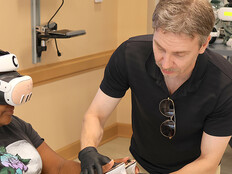







BCI systems can also open up an entirely different dimension of communication for certain students with disabilities. Kinney-Lang explains that normally, a communication partner must first ask the student a question before they can communicate. They must wait for someone to ask, “Are you thirsty?” to reply, “Yes, I am thirsty.” With the assistance of a BCI system, however, the student can immediately ask for water without waiting for a prompt.
Devices Should Be Designed With Students In Mind
The potential is certainly there for bringing BCI into the classroom to assist students with disabilities, even if it might be at least a decade out, as Kinney-Lang predicts. But BCI is a relatively nascent technology, and while today's consumer-grade BCI headsets can be useful for certain basic tasks, they were designed with adults in mind. In order to design BCI systems that work for older and younger students alike, Kinney-Lang says researchers should start with children.
“We should try and improve this technology for kids and really focus on pediatrics, because that scales really well to adults,” Kinney-Lang says. “But building something for an adult does not guarantee it can scale down.”
DISCOVER: What does the ADA Title II deadline mean for your campus procurement strategy?
Personalization of the technology and hardware will be essential if it is to be successful. Instead of working to build a one-size-fits-all option, Kinney-Lang emphasizes that BCI research needs to be more focused on a “one size fits one” option.
Although implanted BCIs exist, Kinney-Lang sees the headset becoming more common in educational environments.
“There’s very little risk there, other than disappointment and maybe discomfort, depending on headrests pushing on pressure points,” he says. “But that’s where occupational therapists and caregivers are excellent at knowing how to make it work.”
Schools Should Consider Data Privacy and Training Prior to Adoption
Successful classroom adoption will also depend on partnering with educators, integrating faculty training to demystify the technology and addressing budget limitations.
There’s also the issue of data privacy, especially when working with a vulnerable group of students. While regulations and laws still need to be created around BCI technology, Kinney-Lang is doing what he can from an engineering perspective to keep brain data safe and secure.
“Right now, the raw brain data comes off the headset and goes to a computer, and the computer processes the data,” he says. “And, to me, there’s a security risk there, because who owns that computer? Who can read that sort of thing? This becomes a bit of a concern.”
By miniaturizing the data processing to a microcontroller that exists on the BCI headset instead of sending the data to a computer to be processed, the raw brain data would never leave the chip.
While researchers continue to tackle neuroprivacy concerns, Kinney-Lang compares BCI technology to the early days of virtual reality and says that there is huge potential but many layers of complexity to consider.
“If you come at it thinking this is going to be a magic assistive technology that’s going to work out of the box and be perfect, I would temper expectations,” he says. “It’s going to take effort and collaboration to build that out for the next generation of BCI users. And that’s where my field is trying to help.”