Close

New Research from CDW Explores AI and Cybersecurity

Learn how AI is helping IT teams manage risk and improve resilience.

Nov 04 2026
Artificial Intelligence

AI Task Forces Drive Policy, Adoption and Innovation in Higher Ed

Colleges and universities are bringing together cross-departmental committees to stay on top of AI advancements and avoid common pitfalls.

Artificial intelligence is arriving on campuses faster than governance can keep up. 

Individual departments and staff members are trying out new tools without the input of IT, leading to creeping shadow AI. Students with the means to access frontier AI models may have an advantage over students who use free versions of AI tools due to limited resources. And faculty are struggling to maintain standards of academic integrity without becoming detectives whose full-time job is hunting down “AI slop.” 

A number of colleges and universities have created cross-functional AI committees, task forces or centers of excellence, ensuring that a representative group of diverse voices helps to shape policies, adoption and use cases. 

“Every area of the institution has been impacted by AI,” says Jenay Robert, research manager at EDUCAUSE. “These impacts include strategic planning, the evolution of policies and guidelines, and daily operations. Effective IT governance must include stakeholders from across the institution so that the governance is informed by all stakeholders’ experiences.” 

Click the banner below to learn how organizations are approaching artificial intelligence adoption.


AI Is a Moving Target

In spring 2023, just months after the public release of ChatGPT, Drexel University convened a task force to develop initial guidance, advise senior leadership and assess the potential impact of AI. The group recommended that Drexel update its academic integrity policy to explicitly address generative AI, create a central website for AI guidance and build a repository of classroom use cases. 

The task force also led to the creation of a permanent, cross-functional AI standing committee to update AI guidance as the technology evolved. 

“AI is a moving target,” notes Steven Weber, senior vice provost for undergraduate affairs and a professor in the College of Engineering and Computing, who co-chairs the standing committee. “Every few months, there has to be new guidance. And there’s incredible heterogeneity in how different disciplines, journals and funding agencies are responding to AI.” 

The committee has helped shape concrete technology and policy decisions. Drexel is a Microsoft shop, and faculty and staff have access to Microsoft Copilot, but the university has also been rolling out ChatGPT Edu licenses in phases, with all students expected to have access by the start of the fall 2026 quarter.

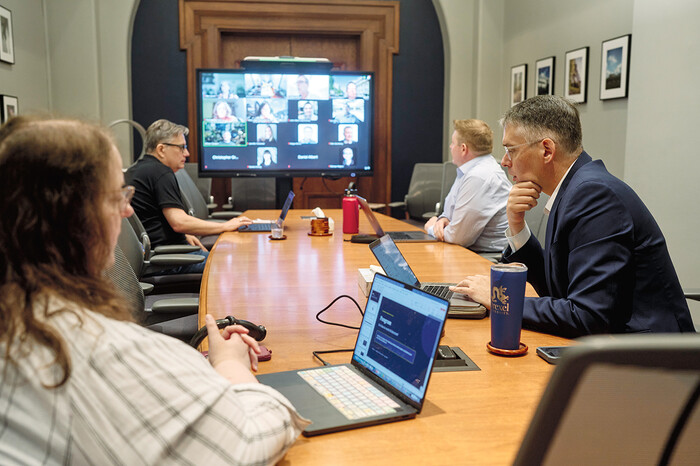
Drexel University’s AI committee
Drexel University’s AI committee stays on top of the latest developments in the technology, and it shapes the institution’s policies accordingly.


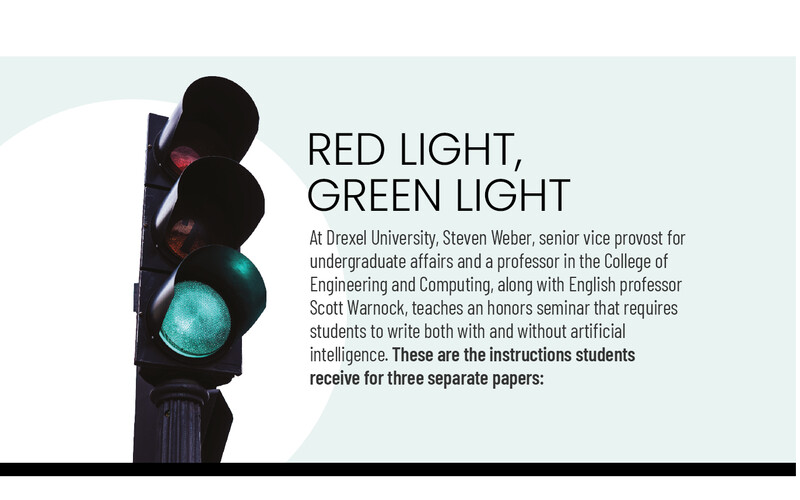
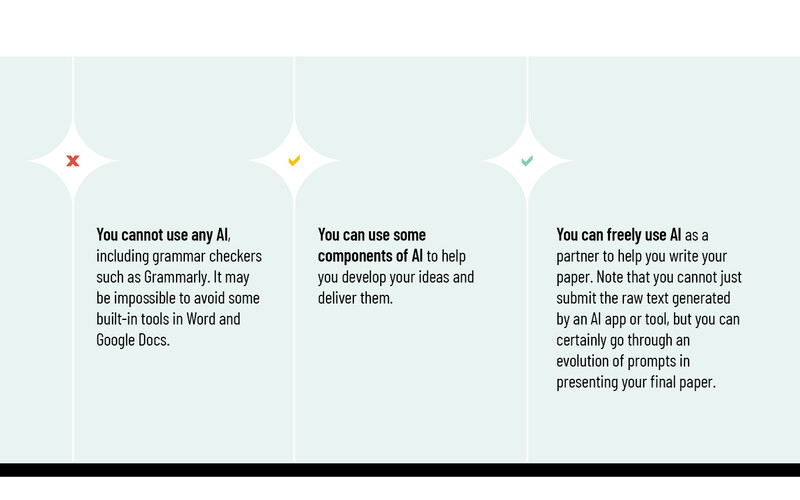
Faculty have broad discretion over whether AI may be used in their courses, but they must clearly explain permitted uses in their syllabuses. The committee also decided that faculty should not rely on AI detectors to determine whether students used the technology to cheat, citing the serious consequences of false positives. 

Looking ahead, Weber says, Drexel plans to incorporate AI literacy into required first-year courses. The goal, he says, is to help students learn how to use the technology without giving up their own voice. “The purpose of a university education is not to acquire knowledge, in my opinion,” he notes. “It’s to learn how to think.” 

Boston University Task Force Provides Both Guidance and Choice

Boston University started with two separate AI task forces, one focused on academics and one on administration. Both converged on the idea of “critical embrace”: recognizing the transformative potential of AI and adopting it in ways that preserve academic freedom and academic excellence. 

DISCOVER: AI centers of excellence centralize governance and adoption.

Those task forces evolved into BU’s AI Development Accelerator (AIDA), an advisory entity that develops guidelines, runs symposia and training and helps members of the university community use AI to innovate. 

“We always thought that AIDA was going to be about faculty, students and staff,” says John Byers, executive director of AIDA and AI adviser to the provost. “So, we took an approach of all of BU, recognizing that there are different constituencies. Someone has to orchestrate that community.”

One of AIDA’s first major actions was to ensure universitywide access to AI tools. The university now offers ChatGPT, Microsoft products, Google Gemini, Claude and Llama through a single portal, letting users choose which AI model best suits their work in the moment. 

Just as important, perhaps, is the cross-functional guidance that an office such as AIDA can provide. “People have a ton of questions,” says Byers. “Not necessarily technology questions, but policy questions: ‘What should I be putting in my syllabus? How should I deal with students who are using AI and plagiarizing? Am I allowed to use AI in my research? Can I use HIPAA data in AI?’”

LEARN MORE: Risk frameworks are key to managing AI-related threats.

Byers notes that these queries are typically best answered not by IT leaders alone but rather by peers with expertise in the same field as the people asking the questions. “That’s what AIDA is really all about,” he says.

University of Missouri Enables Innovation While Enforcing Governance

Leaders at the University of Missouri system wanted an AI environment where faculty could safely use course materials and protected student data, but IT alone couldn’t decide what would make the tool useful in a classroom. So, faculty and IT worked with the university’s AI standing committee to launch Show-Me AI, a secure generative AI platform designed for teaching and learning. 

Faculty can use Show-Me AI to create classroom groups and custom AI assistants, such as a writing assistant that is explicitly instructed to coach students and provide feedback, rather than writing for them.


“We needed to make sure the platform could do what we wanted around security and data,” says Justin Palozola, associate director of AI for the university system and a member of the standing committee. “But we also needed to make sure it had the features that faculty members could use in their class. Even now, as we launch Show-Me AI to all faculty and students, we are still meeting and going over specific features. We’re putting out training to help faculty use these features to invigorate their teaching and help students get the most out of them.” 

Among the university policies stemming from the committee: Instructors must tell students on their syllabuses whether and how AI can be used in their courses. Faculty can use AI tools to assist with feedback, but not to grade student work. And AI detectors cannot be used as proof of cheating. 

“It’s been so valuable to have faculty working alongside IT experts,” says Kevin Brown, associate professor in the Department of Theatre and Performance Studies and chair of the standing committee. “It just makes a really amazing synergy.”

Photography by Gene Smirnov