




1. Start With Readiness, Not Tools
Before investing in platforms or training, find out what people need to understand and what would help them feel psychologically prepared to experiment. We started with listening sessions, faculty brainstorming activities and low-risk experimentation opportunities. These helped surface concerns and build psychological safety. AI does not act on everyone equally because it amplifies both existing skills as well as deficits that people bring to it.
Our initial needs analysis revealed that the biggest barriers to AI adoption were not technical. People expressed uncertainty about ethical use, accuracy, student misuse and their own knowledge. Few were asking which tools to buy.
2. Teach Judgment, Not Just Rules
Many institutions approach AI with policies rather than heuristics. These tend to boil AI use down to what is allowed, limited or prohibited. Our foundational/scalable framework focuses on equipping human professional judgment and growing user confidence in AI decision-making. It guides people to develop a habitual mindset of asking when, why and how AI inputs and outputs are useful to particular tasks.
Foundational skills are those learners need to develop rather than bypass with AI. Scalable skills are those AI can extend or amplify. Without foundational AI skills, scaling is not possible and policies serve only to blindly limit confidence and experimentation. For IT leaders, increasing foundational capacity complements security policies and acceptable-use guidelines by developing the human judgment needed to recognize risks, evaluate outputs and make informed decisions for long-term scalability and sustainability.
DISCOVER: Higher ed institutions are adopting a human-centered approach to technology.
3. Invest in People Before Platforms
Recognizing that AI is an equity issue is crucial to the success of our programming. AI literacy is becoming a condition of employment. We decided early and adamantly to invest in people. Thus, we are spending money on capacity building, not technology purchases. Tools change; the capacity stays. We made sure the project could touch everyone in the college, our community, and beyond. We are also approaching each initiative one at a time, per grant year, instead of launching all of them at once. This helps ensure each has the capacity to succeed before the next begins. Eventually, all of this documentation will end up in an open educational resource library, making it accessible to other institutions.
4. Design for the Range, not the Average
Our AI Innovation Studio brought together faculty and staff with widely varying experience and opinions. We trained everyone from complete beginners to advanced users already building their own bots. Some had enthusiastically adopted AI early without the necessary critical examination or boundaries, while others sought to disprove the use of AI altogether.
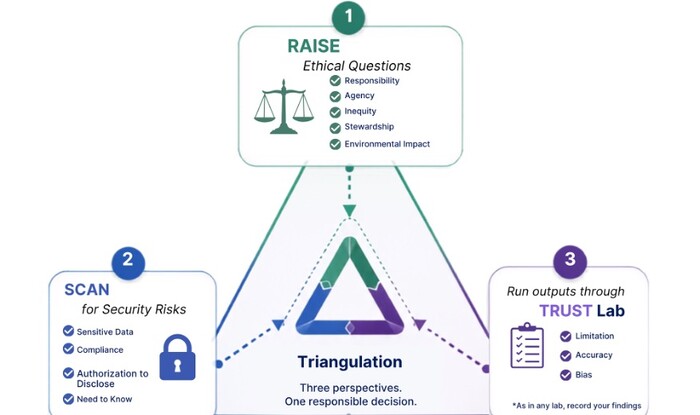
The curriculum that brings this to center is based on a triangulation protocol. The first leg is to raise ethical questions for the context in which AI is being proposed for use. Should I use AI? The second is to scan for security risks pertinent to the information one is entering into the AI tool. How should I safeguard data? Last, outputs are put through a trust lab that structures critical thinking about the applicability and veracity of what AI produces. Is the AI output reliable? This protocol is woven into every training level and product.