




Close

New Workspace Modernization Research from CDW

See how IT leaders are tackling workspace modernization opportunities and challenges.

Feb 20 2026
Classroom

How VR and AI Improve Soft Skills Development

Higher education institutions are turning to training technologies to bridge soft-skills gaps among students.

Are today’s college graduates prepared for the demands of the current job market?

According to a poll by tech training and talent provider General Assembly, nearly half (49%) of executives and a third (37%) of employees felt that entry-level workers were unprepared for the demands of a modern workforce because they lacked “soft skills.” While recent graduates possess firm technical skills and a basic familiarity with newer technologies such as artificial intelligence, they are often short on soft skills such as communication, collaboration and adaptability.

Many universities are turning to virtual reality and AI technologies to help students develop the soft skills they will need to thrive in their future careers.

UNC at Greensboro Develops Cybersecurity Auditing Skills

As part of their education, students attending the University of North Carolina at Greensboro’s Spartan Cyber Guardian Academy develop a solid understanding of the National Institute of Standards and Technology’s Cybersecurity Framework, which will guide much of their future career work with clients. But a key part of the SCGA training program requires students to audit local, nonprofit clients and ask technical questions of nontechnical leaders. Many cybersecurity students struggled with this soft-skills scenario.

Click the banner below to equip your modern learning environments.


“This is the first time they are in front of CISOs and CEOs,” says Moez Farokhnia Hamedani, assistant professor of information systems and supply chain management at UNCG. “They need to communicate with these people, some of whom are not technical. Students have to sometimes rephrase their questions several times. Finding that common ground to get the information they require can be a very challenging task for them.”

SCGA did not have any hands-on activities to help students grow this particular skill set. To address this need, Bahar Pourbehzadi, assistant professor of information systems at UNCG, Nicholas Amoah, an information systems doctoral student, and Farokhnia Hamedani developed a virtual reality game that could assist students in becoming more comfortable as auditors.

“Students start with an AI mentor who explains what the game is and how it works,” Pourbehzadi says. “Then they sit in front of an executive from a company and start asking questions tied to the NIST Framework. The premise of the game is that this person will not get it on the first try, even if you ask a perfect question. Therefore, they will have a follow-up question for you, and this way students have a continued conversation, which helps them develop the required auditing skills. They are then evaluated by the AI mentor and receive tailored feedback to improve their skills.”

The SCGA students access the game using Meta Quest 3 headsets. Pourbehzadi and her team built the game on the Unity development platform. For the AI component, they used a conversational tool called Convai to create the AI mentor in the game.
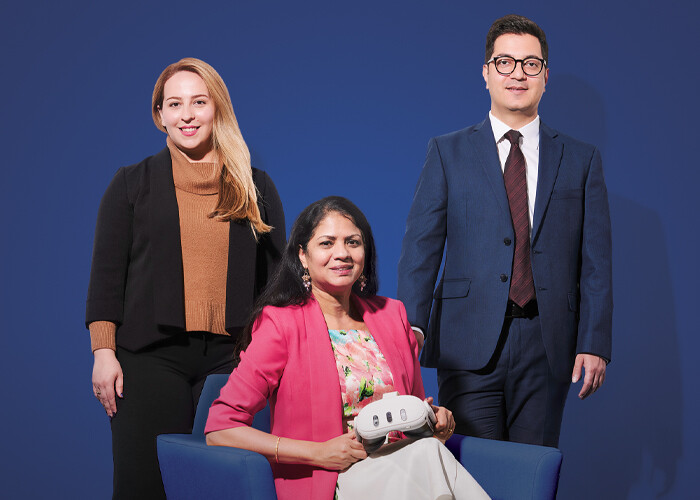

Bahar Pourbehzadi (left), Lakshmi Iyer and Moez Farokhnia Hamedani
At the University of North Carolina Greensboro, Bahar Pourbehzadi (left), Lakshmi Iyer and Moez Farokhnia Hamedani created a VR simulation to give cybersecurity students an advantage when they enter the workforce.


“From a workforce development perspective, these kinds of experiences set our students apart. What we hear from our industry advisory board members is that they want students to have the confidence and the competency to work with clients,” says Lakshmi Iyer, professor and department head of information systems and supply chain management at UNCG. “They want these kinds of soft skills, additional skills that go beyond technical expertise. But too often, their candidates are lacking. So, this VR training is serving a much broader purpose in the industry.”

Beyond preparing SCGA students to more effectively conduct cybersecurity audit interviews with future clients, the VR game and its AI chatbot components deliver additional instructional benefits unique to the technology.

“The most important thing that I've observed is that the AI mentor's feedback to every student has been very consistent,” says Pourbehzadi. “Whereas, with a human educator offering feedback to a classroom of students, the quality might vary from student to student. But with AI, the experience and the quality are very similar for every student. By incorporating AI into a game, students have access to infinite knowledge, which helps deliver consistency.”

VR and AI Bring a Data-Driven Approach to Complex Soft Skills

In her work integrating AI and other emerging technologies into healthcare research and nursing education, Yi-Hui Lee, faculty professor at Wright State University School of Nursing, has found that VR and AI offer many benefits in developing soft skills among nursing students.

DISCOVER: Learn more about how AI and VR can bridge the skills gap in higher ed.

“Teaching soft skills like empathy, communication and teamwork is much more complex than teaching clinical procedures,” Lee says. “AI is a good tool for delivering personalized, data-driven learning. For example, AI can analyze how students communicate with a virtual patient and give immediate feedback on a student's tone and behavior. Typically, clinical settings aren’t appropriate for giving immediate feedback. With AI, not having to wait on feedback from instructors allows students to continue practicing as often as they need.”

Another benefit of using AI to develop soft skills is that it can easily provide a variety of realistic simulations that would be more difficult to produce for students in their nursing program. “The AI can mimic diverse patient responses — their emotional cues, their cultural background — to help a student build that kind of understanding and the communication adaptability they will need in their positions,” she says.

But while AI and VR provide some unique value in teaching soft skills, the technologies have their drawbacks and will not replace human instructors anytime soon, Lee says: “AI cannot fully replicate the shades of human emotion and the complexity of real-world interactions. It can simulate responses by the patient, like body language and cultural context, but it cannot address the ethical dilemmas that arise. That still requires human mentoring and direct clinical experience.”

Source: National Society of Leadership and Success, “Addressing the Soft Skills Gap Between Higher Ed and Employment,” September 2025

University of Miami Medical Students Use VR for Patient Perspective

At the University of Miami Miller School of Medicine, medical students have been using Meta headsets paired with Bodyswaps, an immersive learning platform, as part of a pilot program to enhance their soft skills. Students interact with a variety of patients and scenarios in the VR environment.

LEARN MORE: Modern learning environments can improve student outcomes.

“It provides AI-generated conversation, so you can just talk and get feedback immediately on your body language, your tone of voice, your pace, your eye contact, all of those things in addition to the content of what you're saying,” says Dr. Gauri Agarwal, associate dean for curriculum and associate professor of medicine and medical education at the Miller School of Medicine.

Bodyswaps also allows students to switch positions and experience their interaction from the patient’s perspective. “If a student makes a random gesture for no reason, they can see it for themselves,” she says. “It creates a safe environment for them to practice these skills. We’re looking for ways where we can enhance rather than replace our work.”

The VR simulation also provides an opportunity for interprofessional training with the university’s nursing students.

“We found it really fosters team communication, and hopefully that translates into the clinical environment, and they're more comfortable being open, which is really important in patient safety,” says Agarwal. “It's a gamified experience. It's low stakes, so it's easier to interact with each other.”

Interprofessional training supports a more holistic approach to healthcare and helps deliver better patient outcomes, and Agarwal believes VR can help overcome its logistical challenges.

“It's very hard, logistically and physically, to bring medical students and nursing students together at the same time, because they have different classes, different semesters, different campuses. With the VR headset, students can be anywhere and just dial in and be immersed in this environment together. So, I'm really hoping that it will allow us to do more of this work.”

University of Hawaiʻi Research Scientists Improve Public Speaking

The University of Hawaiʻi at Mānoa developed a VR lab for public speaking as part of a National Science Foundation grant awarded to the university’s College of Tropical Agriculture and Human Resilience. Amy Ebesu Hubbard, a communicology professor at UHM, was added to the research team to help train the scientists to better communicate their highly technical information to nonscientist audiences. The VR lab was built in 2022.

“We discovered that a lot of the scientists that we've worked with don't know how to chitchat with other people,” Hubbard says. “So, we set up the system to give them feedback on their skills with small talk. They learn to engage and to adjust their message to their audience. What seems to work best is to provide some training or coaching ahead of time, then come into the lab to practice.”

Over the past few years, the lab’s technology has been upgraded to include Meta Quest 3 headsets and the Ovation VR platform, which uses AI to improve public speaking and oral communication skills.

“One of the things the VR technology brings is face-saving,” Hubbard says. “Because it's a computer-generated response, it takes away that kind of personal element; it's just this machine providing the feedback. The VR also opens up dialogue for conversations around areas for improvement that may be difficult to initiate, especially if the feedback received previously was softened to avoid hurt feelings.”

Photography by Alex Boerner