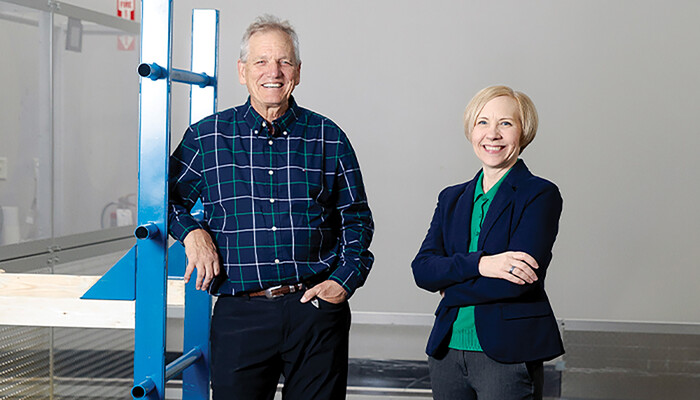
Technology Director for Hemlock Public School District Tom Lockwood (left) and Lockwood STEM Center Director Laura Trombley say demand for the center is encouraging. Photography by Sylvia Jarrus
Industry Partnerships Are Key to Success
While many K–12 districts have found creative ways to incorporate STEM into their curricula, until recently, it was rare to see schools with dedicated facilities for STEM learning. That’s starting to change, experts say, as more districts take advantage of industry partnerships such as the ones that helped fund the Lockwood STEM Center.
“They’re certainly becoming more common,” says Austin Hall, director of policy at the STEM Education Coalition. “But it’s not because schools suddenly have more resources; it’s because they’re engaging with outside organizations and foundations that want to support hands-on STEM education.”
Hall points to data from the National Science Foundation that shows STEM-related professions are growing faster than the educational pipeline can keep up. Companies such as KEEL see investing in STEM programs as a way to create interest in the kinds of jobs they’ll increasingly need to fill in the future.
At Hillsborough County Public Schools in Florida, a collaboration last winter with the Foundation for Community Driven Innovation led to the launch of the HCPS/FCDI STEM Center at Adams Middle School. The center serves as a practice and competition space for the district’s popular robotics and drone programs.
“It was born out of necessity,” explains Catherine White, HCPS supervisor for K–12 STEM. Students had previously used a site at a local mall that FCDI, a local nonprofit, had leased and made available to the community. When the organization lost access to the space in 2025, “they had to box up everything, including their robotics floor, because they didn’t have anywhere else to go,” she says.
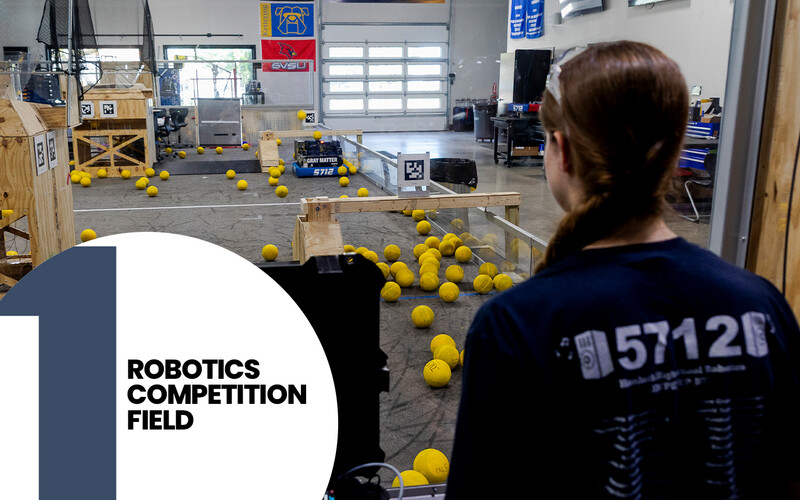
Hoping for a solution that would benefit all, White’s team offered FCDI the middle school’s gym (Adams had recently closed because of falling enrollment) if the organization would give the district free access to its STEM programming infrastructure. The deal was accepted, and now the center is home to several robotics “fields”— designated areas where students can experiment with robots and drones they design and build themselves.
One of the largest school districts in the country, with more than 230 K–12 schools and nearly 220,000 students, HCPS has made STEM education central to the student experience for years, White notes. Children in all grade levels take part in its annual STEM Fair, and eight of its schools have specialized STEM programs funded through grants from the Department of Defense Education Activity. The HCPS/FCDI STEM Center, where students now participate in events like the annual FIRST Robotics Competition, is the district’s latest effort “to make STEM fun while also making it more accessible to more students,” she says.
STEM Centers Equip Students With Real-Life Skills
Giving students easy access to a range of STEM activities — and to promising options in related careers — is also the goal at the Pryor High School Innovation Center in Pryor, Okla. Located within MidAmerica Industrial Park on a branch campus of Rogers State University, the facility is steps away from dozens of industry employers, including the world’s second-largest Google data center.
Pryor High School students come to the space to get hands-on experience in everything from virtual reality programming and computer science to aviation and aerospace engineering. About 120 high school students enroll in the center’s classes each semester, and some choose to supplement the program with coursework at RSU. The center is funded by Pryor Public Schools and through grants it receives from industrial-park businesses and the state educational agency, Oklahoma CareerTech.
Among the current crop of students, one group is building a “FarmBot” to automate the seeding and maintenance of a small garden. Innovation Center Director David Day explains that the students are leveraging open-source software for the project, and they’ll also be writing a business plan with the help of AI tools such as Microsoft Copilot and Google Gemini. Eventually, they’ll grow their own produce and donate it to a community organization that provides support to people in need.
“I think these kids will be prepared for whatever comes next,” Day says. “The skills they’re developing and the things that they’re learning, they’re going to be useful long after school.”