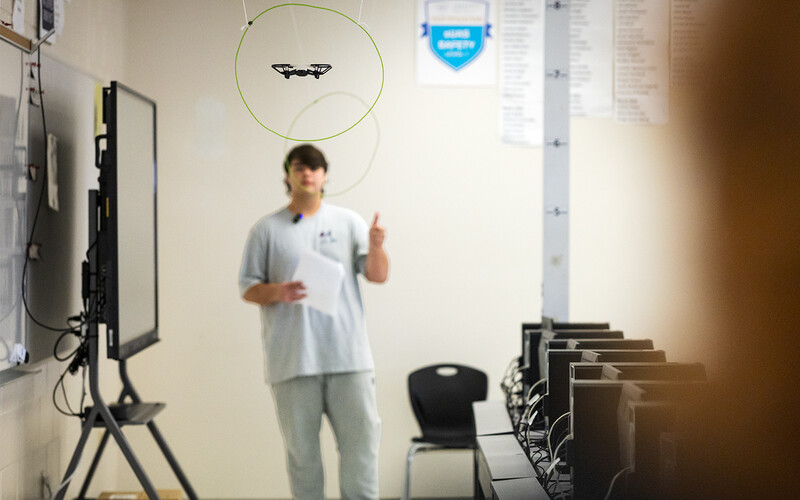
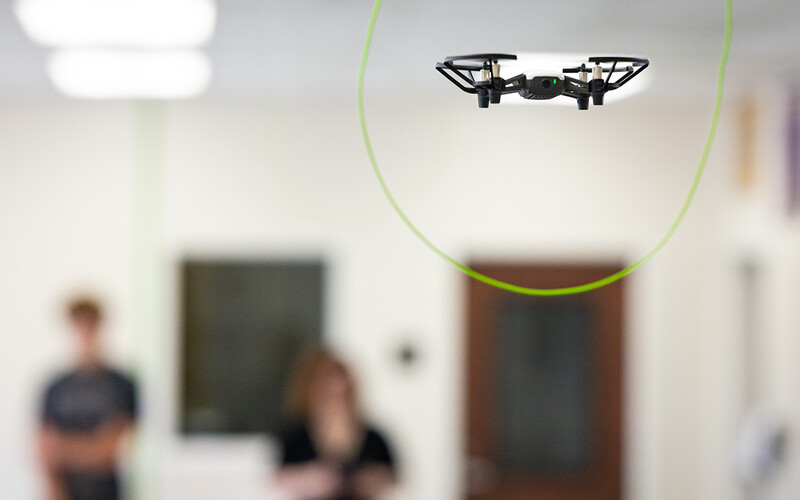
“We worked first in underserved areas, particularly rural areas, where people may use drones to spray crops, or in building trades, like inspections,” explains Marshaun Brooks, CTE supervisor at Washtenaw ISD. Like at East Ridge, the goal is a pathway to FAA 107 certification and opportunities beyond.
Washtenaw began the drone program at two high schools. At one, 9 out of 10 students passed the FAA 107 exam. “And the other missed by just a point,” Brooks says. “That’s nine FAA-certified drone pilots now able to take on work. That’s huge.”
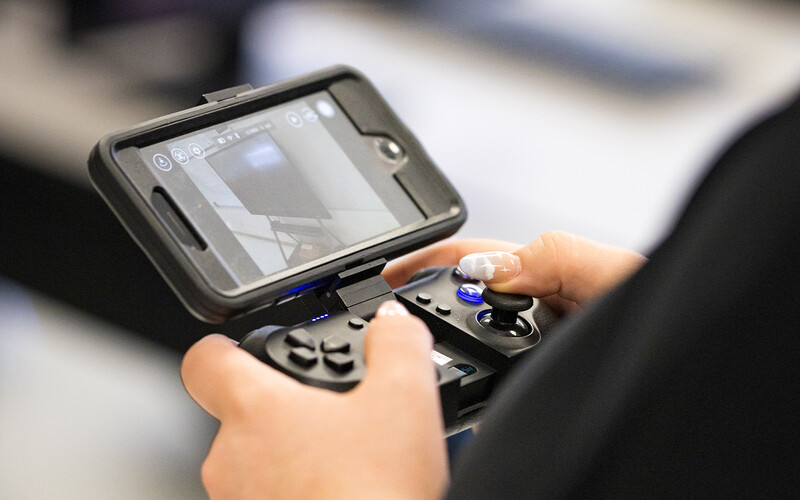
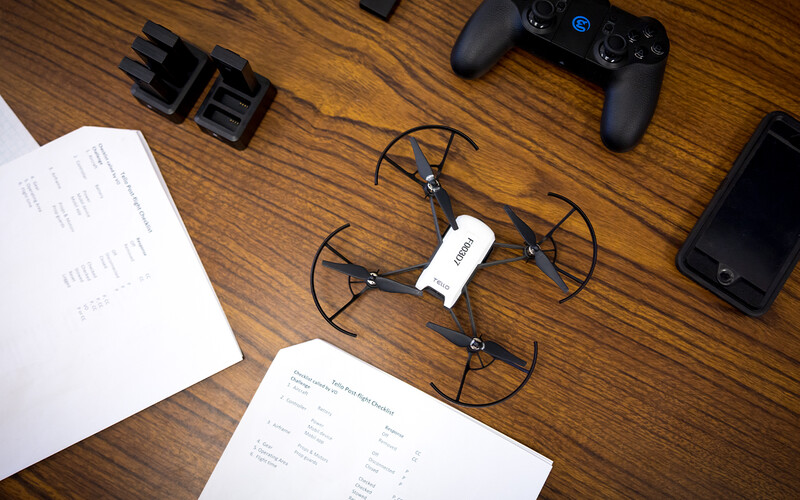
The district uses DJI Neo drones, with students bringing SD cards of video footage back to classrooms for evaluation. Recently, students in the program used their developing skills to perform 3D mapping for a district elementary school that wanted to build a garden on its grounds.
“The biggest challenge right now is getting American-made parts to meet requirements and maintain the drones,” Brook says. “It’s been a bit of an uphill battle.”
The district has explored ways to get younger students interested in drone education, beyond the promise of potential FAA certification. (Students must be 16 years old to take the FAA 107 exam.) Washtenaw ISD now offers an introductory elective course that students can take before entering the state-approved drone pathway program. “It’s a hook to grab kids’ attention and help build capacity,” Brooks says.
And if that isn’t enough?
“Drone soccer.”
Washtenaw ISD currently runs a drone soccer program at one of its schools, drawing students and potential instructors from throughout the district to learn basic skills, foster collaboration and seed the pathway program. One recent event drew more than 100 students and faculty.
In drone soccer, participants on the ground fly drones in a large cage and try to get a ball into a hole at one end while their opponents try to prevent it. “If they crash into each other, they have to recalibrate, reprogram and get back in the race,” Brooks explains.
North Carolina Districts Work To Train Teachers
Regardless of how schools generate interest, K–12 drone programs face similar challenges in addition to meeting acquisition requirements.
“Finding the personnel is probably the biggest challenge,” says Trey Michael, senior director of CTE for the North Carolina Department of Public Instruction. North Carolina receives CTE grant money from the U.S. Department of Education and recently partnered with drone delivery service Zipline on a pathway program that currently reaches 82 schools throughout the state. “The biggest X factor in offering these programs is the instructor,” says Michael.
The state offers professional development for interested faculty and fosters relationships with private companies. “Sometimes, you find people near the end of an aviation-related career who want to give back,” he says.
UP NEXT: Choose the right drone platform for your K–12 education program.
North Carolina’s extensive pathway program comprises three courses: Drone Technology Fundamentals, Drone Technology 1 and Drone Technology 2. Students can sit for the FAA 107 exam at the end of Drone Technology 1, which they must pass before moving on to Technology 2.
Like Washtenaw ISD, North Carolina began the fundamentals course after launching the other two to better develop younger students. It also incorporated into the fundamentals course the FAA’s newer Recreational UAS Safety Test (TRUST), which is now required of anyone flying a recreational drone over a certain weight.
Not all courses are offered at all 82 schools. “Enrollment can ebb and flow based on instructors,” Michael says. In the 2024-2025 school year, about 1,150 students completed Drone Technology 1, considered the “concentrator” course for reporting results to the federal government. Of those, 255 earned their FAA 107 certification and can now fly drones commercially.
“We feel really good about the program,” Michael says. “Those are great outcomes for our students and great outcomes, ultimately, for our economy.”