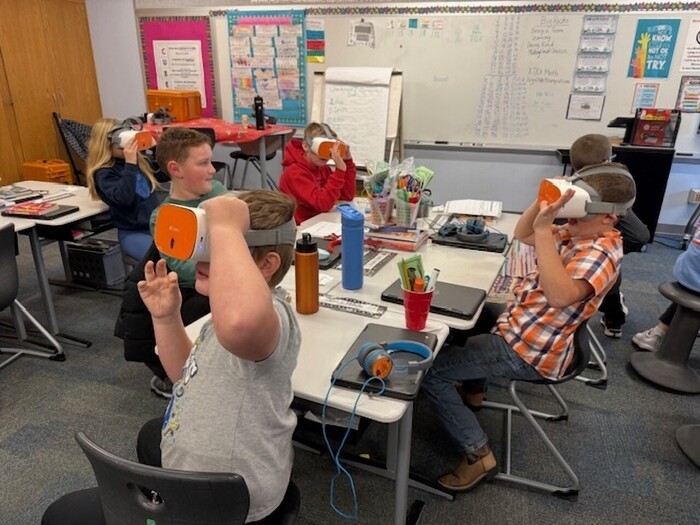
Fourth graders at Twin Lakes School Corporation’s Meadowlawn Elementary School in Indiana have been learning about the Medieval Ages during their reading class. They used ClassVR headsets to virtually travel around Europe, viewing numerous castles and comparing them to the castles from their stories.
Use AR/VR to Lean Into Content Creation
Menghini says when the school was looking for a VR headset, “part of the process was to find a company that not only had a library of good content that would connect to our curriculum but that would also enable kids to create things and see their creations in there.”
“We’re big on kids as creators and not just consumers, and so that was really important to us,” she adds.
For example, for a fourth-grade unit on colonial America, students spent an entire quarter exploring what it was like to live there — from jobs to medicine and other aspects of daily life. Instead of traditional projects like “the dioramas and the poster boards,” Menghini said, she had students first build their colonial settings in Delightex, an online platform for virtual creation. “The huge bonus with ClassVR is that very easily, by scanning a QR code, you can bring what you create into the headset. So, students were able to create colonies that they could walk through, and that they could have their peers walk through.”
At Yealey Elementary School in northern Kentucky’s Boone County School District, blended-learning teacher Craig Dunlap uses ClassVR together with the immersive learning platform ThingLink to help students create their own content.
“I just finished a project with my third graders where we read a book with multiple scenes and settings,” Dunlap says. “I assigned each group a setting, and they used AI generation and ThingLink to create what that setting could have looked like. Then, the students made a video in front of a green screen of them talking about that scene. Then, we put that into ClassVR, and now they’re sitting there and they can actually go from one scene to the next scene to the next scene. It’s pretty intense.”
RELATED: Students explore the world with virtual reality.
Countering Teachers’ Reluctance to Adopt AR/VR
Kyle Kline, director of digital learning at Twin Lakes School Corp. in Monticello, Ind., says his advice to teachers who are hesitant about AR and VR is to “just try it.”
“They don’t necessarily have to put the headsets on themselves, but I want them to have the opportunity to let their kids try them and then watch what the students say and do,” Kline says.
“It never fails, and it really doesn’t matter what grade level we’re talking about. Kids just get so excited. If you can hear all the oohs and aahs and still say, ‘That wasn’t that great of an activity,’ you might want to find another profession.”
High school teachers often tell Kline that they have so much they need to accomplish during a class that they don’t have time for VR, but Kline disagrees. “I tell them, ‘No, you do have time, as long as you’re coupling it with something that you’re already doing.’” Incorporating a VR station into an hour and a half class is a great way to encourage more active learning, he says.
Menghini says teachers shouldn’t feel that they need to master a new technology tool completely before they try it with students. “I think that there’s beauty in the messiness of learning, and for students to see that teachers are also learning something new at the same time,” she says. “All of us are constantly entering into new technologies, especially with the emergence of AI.”
It's OK to start small, says Dunlap. “One of the neat things about ClassVR is that you don’t need a full class set. You can start out by buying eight and see how it goes.”
SUBSCRIBE: Sign up to get the latest EdTech content delivered to your inbox weekly.