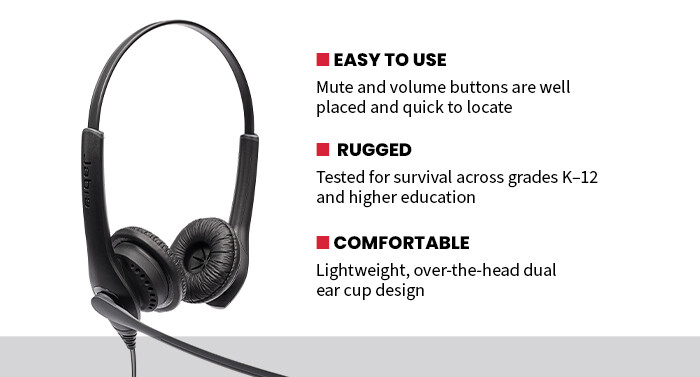






Headset Design Is Comfortable for K–12 Learners
Many schools default to repurposing business headsets or consumer earbuds for student use, a decision that often produces frustration for IT departments and subpar experiences for students. But Jabra takes a different approach with the Biz 1100 EDU, engineering a device specifically for educational use from the ground up. The result is a headset that feels purpose-built rather than retrofitted, with a form factor that is immediately familiar.
The lightweight, over-the-head binaural design with a flexible boom arm microphone weighs just a few ounces, making it comfortable even for younger students. It earns its “featherweight” reputation while remaining easy to use across age groups.
In my testing, the soft leatherette ear cushions proved ideal for extended sessions, including testing blocks that stretched for between 60 and 90 minutes. Students who might otherwise fidget due to discomfort might even forget they are wearing the lightweight headset, which is exactly the goal.
READ MORE: Audio technology is modernizing classrooms.
Microphone and Audio Volume Fit K–12 Environments
Despite the comfortable design, the noise-cancelling microphone is the device’s most important feature for classroom use. In testing across environments such as busy coffee shops and libraries where lots of people were talking and working, the unidirectional mic consistently isolated the speaker’s voice from ambient noise.
Keyboard clatter, nearby conversations and even background traffic sounds were significantly reduced or eliminated in recordings and live calls. That clarity is reinforced by a frequency response range of 80 hertz to 20 kilohertz, which delivers clean, balanced audio for both listening and speaking.
For K–12 deployments, hearing protection is essential. The Biz 1100 EDU addresses this with Jabra’s PeakStop technology, which acts as an active limiter against sudden audio spikes.
PeakStop intervenes before sound levels reach potentially harmful thresholds, whether from a sudden media volume surge or accidental user adjustment. This is especially important for younger students, whose developing hearing is more sensitive to noise exposure, but it would be equally valuable for college environments. For districts navigating compliance with safety guidelines or state technology standards, this feature provides a built-in safeguard that can reduce risk.
The Jabra Biz 1100 EDU is a well-executed product that addresses the real challenges schools face with audio peripherals: short hardware lifecycles, inconsistent audio quality, compatibility issues and student safety.
It doesn’t try to do too much, and what it does, it does well. For IT leaders evaluating headset deployments in K–12 environments, whether for labs, testing or hybrid learning, the Biz 1100 EDU belongs at the top of the list. For higher education institutions managing shared devices in libraries, labs or remote learning programs, it’s also worth serious consideration.