



Jan 09 2026
Artificial Intelligence

Bronx Students Trade Traditional Lessons for Hands-On AI Training

A workshop on artificial intelligence for NYC students put on by CDW and Salesforce helps ensure young people are thinking about their place in the emerging economy.

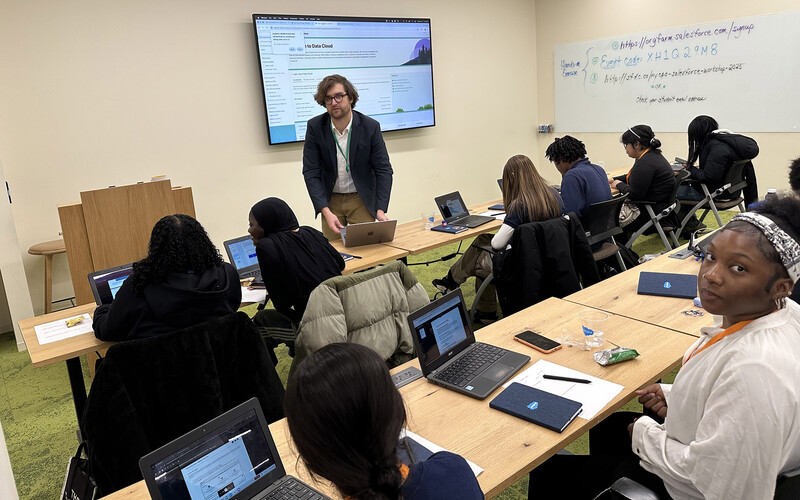
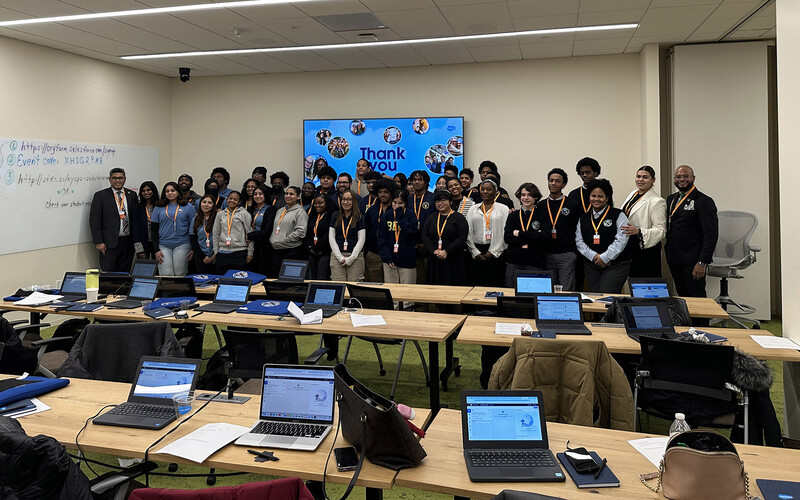
Artificial intelligence agents are reshaping every industry in America, and most adults are still trying to understand what that means. But on a recent afternoon at Salesforce Tower in Midtown Manhattan, a group of Bronx teenagers were getting a chance to build their own.

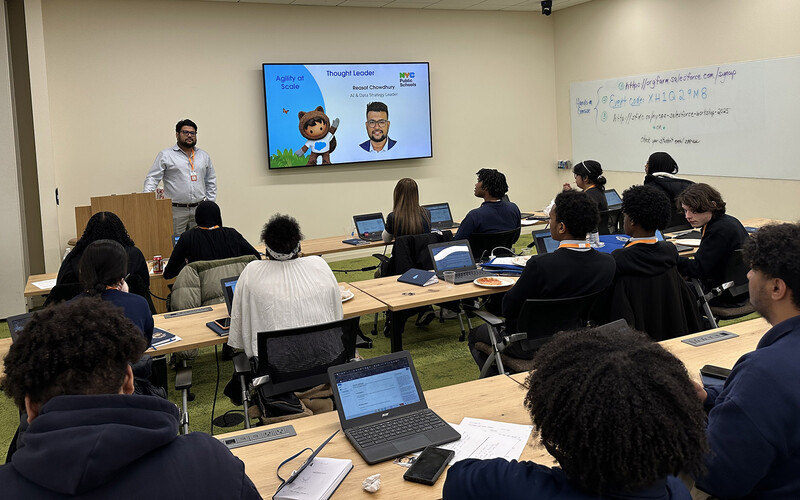
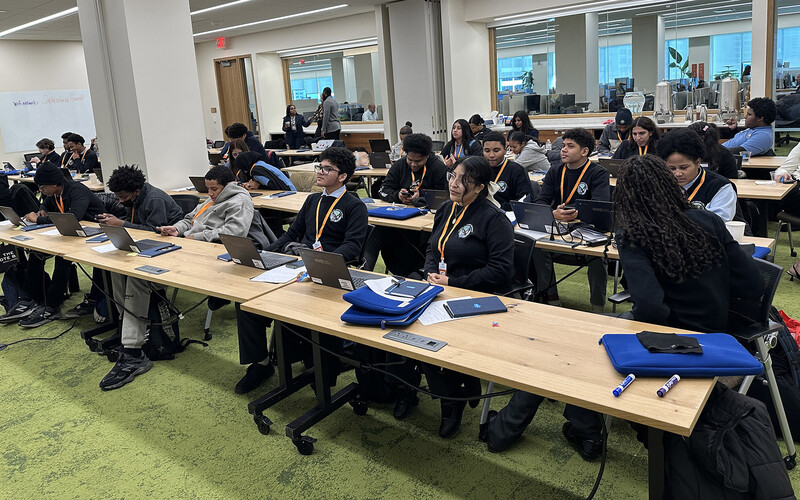
Thanks to a collaboration with CDW, Salesforce and the New York City Department of Education, these students were treated to a lecture and hands-on workshop that guided them through the process of creating their very own AI agents.

"Knowing how to work with and build these AI agents will be a superpower,” said Sabastian Niles, president and chief legal officer at Salesforce, as he welcomed the students to the company’s New York headquarters. “By learning to build an agent on the Salesforce Platform, you are all becoming Agentforce trailblazers and gaining a skill set today that some of the biggest companies in the world are currently racing to learn."

The students gathered for the AI workshop came from three Bronx high schools: The Academy for Language and Technology (ALT), Bronx Early College Academy (BECA) and  the Metropolitan Soundview High School.

“Today started with just an idea, and that idea was to give students the opportunities and direction I wish I had when I was their age,” said Jeremy Servian, New York City schools client executive at CDW. “It's so exciting to see this all come together today, and even more exciting to see how appreciative the kids are to be here.”

Click the banner below to learn more about the shifting AI landscape.


Guiding Students Through the Process of Building an AI Agent

As workshop leaders quizzed the students on whether they were familiar with some of the terms associated with AI, such as retrieval-augmented generation or unstructured data, you could see that students were entering largely uncharted waters. Many stared blankly as some of the words were introduced.

To help the students grasp what it means to play with prompt engineering and create an AI agent, workshop leaders presented an exercise tasking the students with building a customer service AI agent, using Salesforce’s Agentforce platform, for a mock hotel called the Coral Cloud Resort. The students fed the agent a list of answers to some FAQs to give it context and guidelines that would enable it to fulfill its mission. Answers included information on checkout time, requesting adjoining rooms and whether pets are allowed.

After learning some of the fundamentals of building an AI agent, students were set loose to start playing and building their agents.

“We’re getting a sense and background on AI and how the world is changing through AI,” said 16-year-old Kendrick Peguero. He plays baseball and is currently focused on getting into college and studying sports medicine. But after learning about AI and tinkering with his own agent, he’s open to considering something having to do with computers.

For Nadia Arias, also 16, visiting a major company such as Salesforce and learning about AI is something she says would have been out of reach in her native country, the Dominican Republic.

“It’s my first time going to an event like this, and it’s so interesting being around all these fancy people,” she said. “I already work with AI, but this inspires me to do a lot more things. Literally, it opened a door for a new world of opportunities for me.”
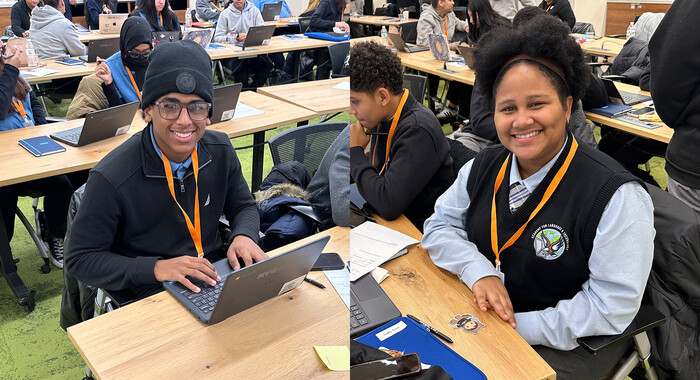
Students at NYC public schools
Kendrick Peguero and Nadia Arias learn about AI opportunities at a CDW/Salesforce workshop.


NYC Public Schools’ Journey with AI

As the largest school district in the country, many New York City Public Schools leaders initially had a reactive approach to AI. But the district’s tech team took a much longer-term view of AI and has been able to get the district to move from banning it to embracing it.

For example, the district is currently looking at integrating AI in special education to support management of individualized education programs. Having AI take on more of the administrative burden with IEPs would free educators to focus on providing more direct support to special education students.

Of course, there’s also the daunting task of integrating AI into classroom instruction.

“The DOE is figuring out how to train you guys to use AI and use it properly, and how to teach teachers to teach AI,” said Demond Waters, CISO for New York City Public Schools. “We’re just scratching the surface, and this is going to change education significantly over time.”

Personalized instruction is one area where Waters sees an immense amount of opportunity for the district.

READ MORE: How school leaders are using Gemini to optimize education.

“One thing that AI is going to do is adapt to the type of learner that you are. I think that’s the goal of AI in education, to help meet kids where they’re at,” he said.

But the excitement around AI was tempered with caution by district leaders. Because they’re dealing with education and children, there’s a need to focus not only on the tech but on building community trust, which will be necessary to help parents, teachers, students and administrators navigate the changes.

“After a three-year journey with AI, it’s not about building systems or tools, it’s about building trust,” said Reasat Chowdhury, AI and data strategy Leader for New York City Public Schools. “The trust comes when you don’t work in isolation, but when you work as a team.”

The district must also balance embracing AI with making sure students know that AI is a tool — not a replacement for their own critical thinking and judgment.

“Don’t just look for ease,” Waters said. “You’re still going to need your critical thinking and problem-solving skills to survive in this world. You have to think critically to understand what’s real and not real. You also have to make decisions on if these things are helping you or harming you.”

What It Means To Expose Students to Technology and Opportunity

Several district leaders cited their own journeys with technology and growing up as a way of connecting with the young minds in the room.

“There is one metric that’s not often looked at, and it’s people having exposure and opportunities,” said Alex Williams, deputy superintendent of infrastructure for NYC DOE.

“I was halfway through my senior year of high school and I got kicked out,” he admitted.

Williams went to school in Brooklyn’s Clinton Hill neighborhood. He was kicked out of school because he arrived late every day due to transportation challenges. He ended up pursuing his GED, as he had to prioritize work: At 17, he had to provide for a daughter and had another child on the way. He found himself making $5.25 an hour as a security guard on 34th St. at a department store. Then, an opportunity at a temp job gave him his first brush with a mainframe computer — and exposure to the idea of tech as a career.

Today, he’s a seasoned IT professional working for the nation’s largest school district. He has stock options and stability in his life. He chalks up this happy ending to getting the right exposure and the right opportunity.

“That’s what exposure gave me. Exposure made me aware of an opportunity,” he said. “Everyone has a story. The decisions you make today can have an impact on your life. We’re living proof of that.”

Demond Waters
You’re still going to need your critical thinking and problem-solving skills to survive in this world. You have to think critically to understand what’s real and not real.”

Demond Waters CISO for New York City Public Schools

For Carl Manalo, superintendent of Bronx High School Districts 7, 9 and 12, his own journey with technology helps him appreciate the exposure his students are getting to AI today.

“I grew up right in the Bronx, up on Castle Hill Avenue. I have to tell you, these opportunities were not there for me,” he said. “I didn’t know what I wanted until I saw it. So, this is a chance to look around and imagine yourself in spaces like this.”

As a young man, he was exposed to the BASIC programming language, which he credits with making him a good AI prompt writer today — that, and his love of exploring and conquering side quests in video games.

“Today is a side quest on your way to success,” he said. “I always say this: The Bronx is full of brilliance. You, sitting here, each and every one of you is proof of that.”

The ability for students to engage with emerging technology is informed by the knowledge and expertise that CDW has built up over decades. In fact, many people working in the company’s education segment are former educators themselves. This direct instructional knowledge, paired with CDW’s integrated relationship with leading partners such as Salesforce, allows CDW to bring opportunities like this to school districts including New York City Public Schools.

“As a nontraditional educator now working for CDW, it’s amazing to help create partnerships, like this one with New York City Public Schools, to help our students prepare themselves for their futures with an understanding of the power of AI,” said Corey Gordon, senior national educational strategist at CDW.

UP NEXT: What IT leaders need to know about the the rise of agentic AI.

Ricky Ribeiro
Close

New Workspace Modernization Research from CDW

See how IT leaders are tackling workspace modernization opportunities and challenges.