Calvin Hennick is a freelance journalist who specializes in business and technology writing. He is a contributor to the CDW family of technology magazines.
Wickenburg, Ariz., bills itself as “The Roping Capital of the World.” The 8,000-person town, located about 50 miles northeast of Phoenix, features more than half a dozen roping arenas, and rodeo cowboys and cowgirls travel from around the country each winter to showcase their cattle-roping skills.
Wickenburg Unified School District is trying to lasso a challenge even trickier than a runaway steer: bringing AI to nearly 1,000 students on a rural district’s budget.
“Being a smaller, rural district, we definitely don’t have the budget that some of these districts down in the greater Phoenix area have,” says Jeremy Courliss, IT director for Wickenburg USD. “But I also think we’ve done a pretty good job with taking our time. There are some districts that opened it up for everybody, without much training or guidance. I’m really proud of the work we’ve done so far.”
Rural educators see the way AI has begun to reshape K–12 education, from tutoring bots that provide individualized instruction to tools that help teachers brainstorm instructional activities, design better assessments and differentiate their instruction. But even as they embrace the technology, they must navigate roadblocks including budget constraints, limited student broadband access and smaller staff pools. In a May 2025 survey, Gallup found that students living in counties with a median household income under $60,000 per year, as well as those in rural areas, are least likely to say their school allows them to use AI and are especially likely to say their school has not established rules regarding AI use.
Jessica Garner, senior director of innovative learning at ISTE+ASCD, notes that some K–12 leaders are hesitant to adopt AI tools out of fear that they will be used irresponsibly. “I think some schools are still trying to figure out the appropriate uses, and they’re still working on their plans for AI literacy,” she says. “Schools definitely need to put guardrails in place to protect students. But we can’t wait until we have everything else perfectly figured out before we roll it out to students, because kids are already using it.”
Getting Started With Limited Budgets
Garner says she recently spoke to a superintendent who wanted to buy Gemini Pro licenses for all of his teachers. But at $20 per month, per user, the purchase would come out to nearly $100,000 a year for 400 teachers. “It gets pricey pretty quickly, and many districts just don’t have that kind of money,” she says.
Wickenburg is getting around this funding challenge by simply encouraging students and faculty to use the free versions of AI tools like ChatGPT, Gemini, Canva and MagicSchool AI. The free tools typically offer a limited number of prompts, and they sometimes restrict access to the latest AI models, but they also offer a no-cost way for educators and students to begin learning how to use AI.
“By the end of this year, we would like to choose a platform or two and start figuring out licensing,” Courliss says. “We are a Google shop, so we would probably look at what it would cost to increase our level with Gemini. But at this point, we’re just dipping our toes into things and not making any commitments.”
Back to the articleAutoplayFull ScreenGrid ViewExit Full Screen
Wickenburg’s AI committee borrows heavily from larger districts like Chicago Public Schools.
Wickenburg High School serves a rural community in Arizona of approximately 8,000 people.
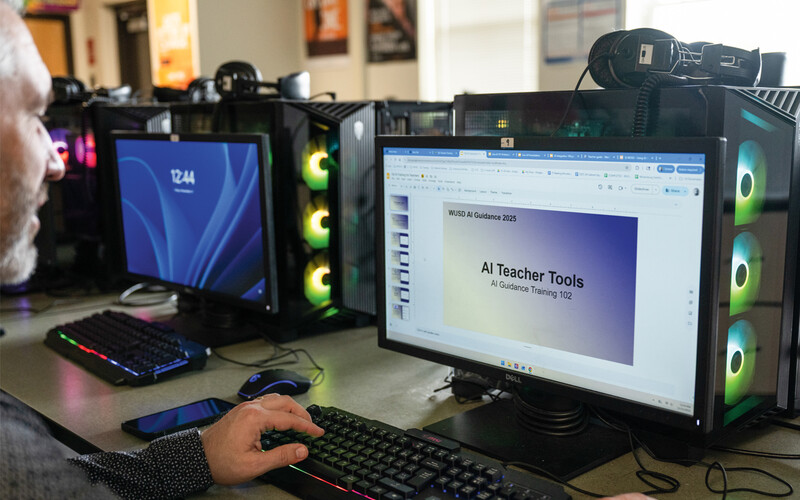
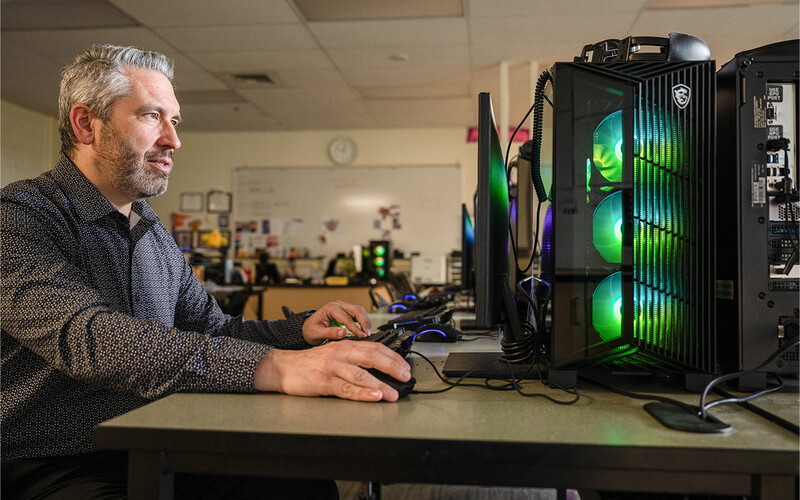
Jeremy Courliss, IT director for Wickenburg USD, reviews the district’s AI training curriculum.
Wickenburg’s AI committee borrows heavily from larger districts like Chicago Public Schools.
Wickenburg High School serves a rural community in Arizona of approximately 8,000 people.
Jeremy Courliss, IT director for Wickenburg USD, reviews the district’s AI training curriculum.
Back to the articleAutoplayFull ScreenGrid ViewExit Full Screen
Wickenburg’s AI committee borrows heavily from larger districts like Chicago Public Schools.
Wickenburg High School serves a rural community in Arizona of approximately 8,000 people.
Jeremy Courliss, IT director for Wickenburg USD, reviews the district’s AI training curriculum.
Wickenburg’s AI committee borrows heavily from larger districts like Chicago Public Schools.
Wickenburg High School serves a rural community in Arizona of approximately 8,000 people.
Jeremy Courliss, IT director for Wickenburg USD, reviews the district’s AI training curriculum.
Last year, Wickenburg created an AI committee that developed a training curriculum, borrowing heavily from larger districts like Chicago Public Schools rather than “reinventing the wheel,” Courliss says. The committee spent the entire year training teachers before rolling out any student access, and now teachers are leading students through lessons on data privacy, security and even how to parse user agreements. Students who lack broadband access at home can borrow a mobile hotspot from the district, extending AI access across the district’s 1,100 square miles.
So far, Courliss says, students have begun using AI tools for math tutoring and overcoming writer’s block. Teachers, meanwhile, are using the tools to adjust the tone on emails to parents, brainstorm classroom activities and revise their lessons. “They know what they’re going to be doing and how they’re going to teach it,” Courliss says. “But these tools help them keep things fresh.”
Support for Planning and Critical Thinking
Amy Graeber, chief instructional officer for the 4,000-student Uvalde Consolidated Independent School District in Texas, knows that some teachers are wary of AI, concerned that it will lead to widespread cheating. But Graeber believes it can be a tool that helps students deepen their thinking.
“What kinds of questions are we putting in front of students? Questions they can answer with quick recall?” Graeber says. “If so, we have to ask ourselves whether those are the questions that truly push their thinking. Our goal with AI is to elevate critical thinking and deepen academic discourse. It’s not about getting an answer; it’s about expanding their thinking.”
For example, elementary students in Uvalde recently used AI to help them plan for a project. The students had recently read about the Aztec Empire, and their teacher asked them to create a 3D model of an Aztec temple using common household objects. Before building their models, the kids used AI tools to brainstorm how they might be able to use the coffee cans and soda bottles they had at home. They even used AI to generate images to help them conceptualize their models.
Uvalde has a one-to-one program with tablets that are cellular-capable. Students without Wi-Fi at home can ask the district to turn on the signal for their device, ensuring that all students can access AI tools on nights and weekends.
Largely, students and teachers are using a mix of ChatGPT, MagicSchool AI and NotebookLM, a free Google tool designed to help users extract insights from their own documents and data. Because NotebookLM grounds its responses in users’ source materials, it “hallucinates” far less than other AI tools, and teachers upload their curricula and then use it as a planning partner.
David Zamora Jr., technology director for Uvalde CISD, says the district is still in “trial and error” mode, learning which tools best meet students’ and teachers’ needs — and how to put guardrails around them. “It’s just learning from experiences, figuring out what works and what doesn’t work, and what policies we have to modify for the future,” he says. “It’s one step at a time.”
North Carolina District Launches AI-Focused Microschool
Elizabeth City-Pasquotank Public Schools in eastern North Carolina is experimenting with AI across the district, but the technology is central to a 26-student microschool launched this fall. Twenty-six fifth and sixth grade students are running an Airbnb to learn real-world lessons about business, and the district plans to add one grade per year, eventually reaching approximately 65 students across grades five through eight.
The microschool will have only three teachers and one support staffer to teach all subjects across each of the grades, making AI instruction essential.
16%
The percentage of teachers at rural schools who are AI users, compared with 21% at suburban schools
Source: RAND, “Using Artificial Intelligence Tools in K-12 Classrooms,” April 2024
“Clearly, three people are not going to be able to teach four grade levels of content to 65 kids,” says Superintendent Keith Parker. “So, the great experiment here for us is, we’re really interested in this idea of the changing nature of the educator. You need human beings who can facilitate and manage relationships with kids to create spaces where AI could replicate grade-level, content-specific instruction and tutoring, under the direction and supervision of an adult.”
Currently, teachers at the microschool are delivering some direct instruction. But they are also supporting students as they access the AI tutoring tool Khanmigo on their tablets. “The students will put in prompts asking for the answer to a problem, and the AI tool will actually prompt them for more information,” says Heather Edmisten, director of technology services. “It doesn’t tell them the answer. It walks them through how to solve the problem.”
Across the rest of the district, students are using free versions of AI tools like ChatGPT to help explain math concepts and get feedback on their writing. Parker says the district may make AI tools a key component of their annual 60-day push starting in February to review previous content in preparation for standardized tests.
Parker sees AI as the next step in the long journey away from traditional “sage on the stage” instruction, where teachers deliver long lectures while students listen. “Most of our kids learn through TikTok videos,” he says. “When a teacher gives them a 20-minute lecture, and then they have to read five pages of information, that is just not how they are accustomed to learning new things.”
“The role of the educator will be massively different in three years,” Parker adds. “The places that don't recognize the momentum of change run the risk of becoming irrelevant to kids.”
The Impact of AI in K–12
ISTE+ASCD’s GenerationAI program aims to equip K–12 educators with the knowledge, tools and confidence to safely and responsibly use AI in the classroom. According to the organization, these are some of the most significant impacts of the technology:
Enables greater and more effective differentiation and personalization at an individual level
Helps teachers discover innovative ways to teach, including suggesting new instructional strategies
Provides educators with insight about student learning gains and gaps
Helps educators and instructional leaders to rethink and design better, more authentic assessments
Increases efficiency and reduces workload for teachers by helping with tasks such as lesson planning, email drafting and generating quiz questions