



Dec 16 2025
Artificial Intelligence

Q&A: Matthew Winters Champions AI Literacy in Utah

As the Utah State Board of Education’s first artificial intelligence specialist, Matthew Winters brings his passion for professional development to this role.

With a career that spans classroom education, teacher training and a role with the state’s educational broadband organization, Winters is no stranger to putting new technologies in front of students, teachers and administrators. EdTech spoke with Winters about how he works to advance AI education and initiatives across the state.

Click the banner below for deeper insight into the evolving AI landscape.


EDTECH: What drove Utah to create this role?

WINTERS: It started out of visionary leadership. Our state superintendent and deputy superintendent when I was hired, and our new superintendency are big proponents of educational technology, and they had started prioritizing AI. They recognized how fast this conversation is because it's a technology that's not idiosyncratic. It's in everything, and we have to have somebody navigating that full time. 

As written, my role is three parts. I work with legislative and policy stakeholders. I have standing meetings with legislators about AI. I work with our Office of AI Policy, which is also the first of its kind in our Department of Commerce. I do a lot of outreach with national nonprofits and organizations. 

Second, I work with our districts and charter schools to make sure that they're trained and have the support they need, but I also help their leadership to navigate policy conversations. We're starting to see some good dividends pay out of that. 

Third, I do internal professional development. I work with a lot of our internal teams and help them support AI growth and use. I also address what that means for their content areas. That's why the role exists, and I think it's a necessary role right now. I think more states are recognizing how pervasive and problematic this conversation can be, and having somebody at the forefront that's the point person that can work with multiple teams at once is really helpful.

RELATED: Training is key to AI success in K–12 districts.

EDTECH: What is the AI Framework for Utah P–12 Education, and what are its key takeaways?

WINTERS: It was built before I was hired, but what’s great about coming into the role is that it's a living document. Right now, I am trying to do a revision on it because we're starting to see agentic starting to come up, along with a few other kinds of high-profile shifts in how we think about AI, and I know districts are going to need support on those. 

I think that's a big takeaway for other states: Make it a living document that's editable and changeable. The framework really outlines, first, the laws and codes that govern the conversation around AI — federally and statewide — but then it digs into appropriate use and offers some resources. It's meant to be, not bare bones, but definitely nondirective for a local education agency so it can make the decisions on what is best for the local community. 

A lot of them have taken our frameworks, and I’ve also collected a lot of the frameworks across the state and handed them off to the stakeholders who oversee building those in districts, and said, “Here's what all of your colleagues are doing. Now you have an example, and you can start building something.” This has helped support local agencies that are slower to progress in this kind of ed tech conversation. We’re seeing a lot of growth, and it comes down to the fact that we have a flexible framework that is nonpunitive. It's mostly about figuring out the best way to work this through as a group and get us to a good place.
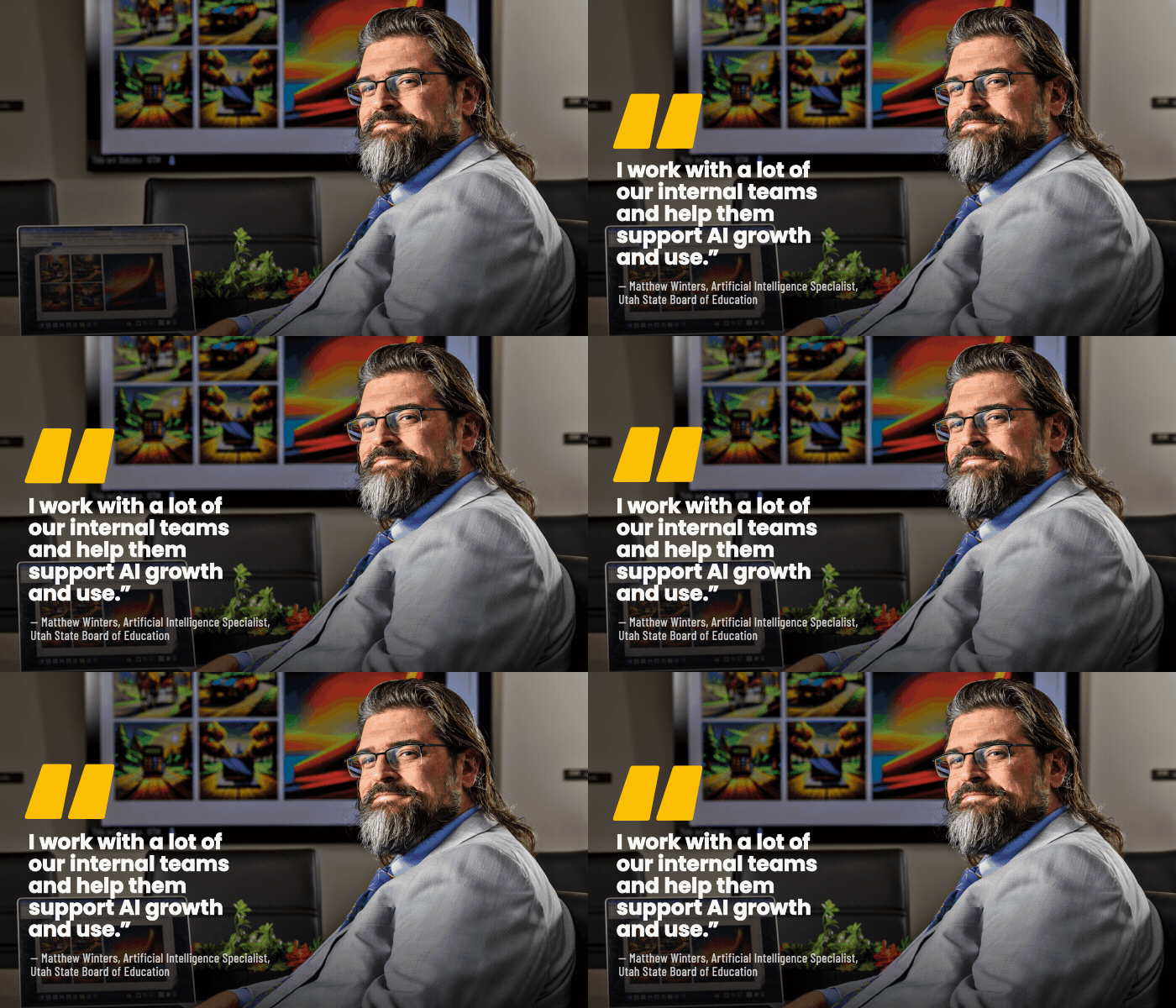

Matthew Winters


EDTECH: What are you working on right now that you’re excited about?

WINTERS: Intermountain Healthcare, one of our local health providers, gave the Utah State Board of Education a half-million-dollar grant, and the focus was to build AI literacy in teachers. The goal of the program was to train teachers with one hour of PD. Then they have the option to join a two- to three-hour Canvas course, and at the end of that, they write a lesson plan. 

We were hoping for 1,500 teachers. We’ve been past 5,600 since April. About 1,500 of them have gone on to the optional course, and 700 have completed lesson plans. We're going to be posting those free of charge for anybody globally to look at. We're hoping that we can be the database that researchers look at for emerging practices and then be able to verify those or try them out across the globe. 

The other side of that is we were able to provide leadership training. We've done leadership training with about 150 school- or district-level employees, but we've also been able to fund training with superintendencies and school boards. Next is figuring out how to get funding for training parents and students. I'm working with a few funders to get that done.  

About six months ago, we pulled together a group of higher ed students, teachers and professionals in K–12 special education at the agency to create a Portrait of a Graduate focused on AI. What came of that was a portrait of an AI-Infused Educator and a portrait of an AI-Infused Learner. Their guidance is around the knowledge, skills and dispositions that a student or a teacher may need to thrive in our AI-infused world. It has the traditional skills that we want students to have, like critical thinking and creativity and communication. But there are things like prompt engineering data privacy that are equally important for them to understand and think through. We're trying to really get this out and share that it's possible to envision what you want from this ecosystem, and here are pathways to make that happen. 

DIVE DEEPER: To facilitate AI literacy, teachers need to understand AI too.

EDTECH: Utah has a lot of rural districts, which are often under-resourced. How do you address the issues of access and equity when it comes to AI?

WINTERS: In 1994, the governor asked the Utah Education Network to build the broadband network. So now, if you go into a public school in Utah, whether a charter or a district school, the internet is free through the Utah Education Network. Right now, if you're on the Wasatch Front, which is largely urban and suburban, you're looking at 400 gigabits per second, and it's a massively fast network for students. That extends all over the state. In our extremely rural areas, there's internet available to every school. Having that network that we can use to run programs through AI is really helpful.

The other thing that's really been helpful for me and for the rural networks is we have four extremely active rural service centers, and each one covers anywhere from four to seven districts that are extremely rural. They have trainers, support folks and IT professionals. We just did a leadership summit, and I immediately said, we need to have one of these in rural Utah. We need to pick a spot that's centralized, so as many people as possible can get there, and we need to work with the rural service centers to make sure that this is getting out to all of our districts. We got 60 people at that, which doesn't sound like a lot, but it’s a lot for rural Utah. The four directors of the rural service centers were there, so they collaborated in the room about AI as well.

SUBSCRIBE: Sign up to get the latest EdTech content delivered to your inbox weekly.


EDTECH: How would you advise other state boards of education to prioritize AI?

WINTERS: Having a statewide network is key. It's not corporate-owned, it's government-owned, and it's helped achieve so many things that we weren't expecting in terms of ed tech. 

Generative AI is such a fast-moving conversation, and it's pernicious. There are issues in it that are deep-seated; if they go unchecked in the school or district environment, they could cause all sorts of problems down the line. Beyond that, it also can be a wonderful solution to some of the things we've been trying to solve for in education, like personalized learning or competency-based learning.

If a state board team is thinking about this, I would advise them to find somebody who has a critical lens on AI. The second thing I'd say is start working across agencies. I spend a lot of time with the Office of AI Policy because our students are consumers. As soon as students leave the school building, if they're not on a school laptop or a school-issued device, they have access to all sorts of stuff with AI that can be deeply problematic, and we're seeing the effects of that in real time. Things like character chatbots, mental health chatbots and deep fakes are all things that will affect our students in class, but then also as a consumer outside of class, and having those connections as a state board is essential so that we can protect our most vulnerable population.

Start working with your higher ed partners. I spend time with almost every university across the state every month because they're asking big questions about how to train our teachers and how to move K–12 students into higher ed for the workforce. If you don't have that higher ed partnership, you're not going to be able to fill the pipeline, whether that’s K–12 to higher ed or trade schools to the workforce.

Photography by Kim Raff
Close

New Workspace Modernization Research from CDW

See how IT leaders are tackling workspace modernization opportunities and challenges.