






“We take a two-pronged approach to AI on campus,” shares José Rodriguez, vice president and CIO at Pomona College. “Administrative staff use Microsoft 365 and its AI-powered assistant Copilot for their work, while faculty have access to environments that allow them to build custom LLMs for the classroom and research.”
How Pomona College’s AI Solution Reduces Food Waste
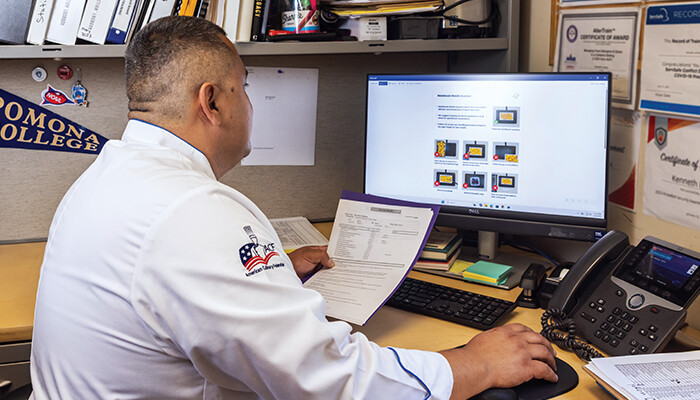
Each dining hall kitchen has a smart scanning station that pairs a tablet interface with a 3D computer vision camera, weight sensors and an infrared sensor to capture food volume, weight and temperature in real time. The software that manages the system uses AI models that run both on the device and in the cloud.
“The edge computing piece allows for instant identification of food items and provides real-time feedback,” says Jose Martinez, general manager of dining services at Pomona College. “The cloud platform aggregates data into a dashboard, reports and forecasting tools. Altogether, it gives us a live, end-to-end view of what is being produced, consumed and wasted.”
With the solution in place, Dining Services has gained a level of visibility and control that staff did not have before, allowing them to make decisions in real time, rather than reacting after the fact.
“We now have precise data on overproduction, consumption patterns and plate waste across different dining halls and menu items,” Martinez says. “For example, we have identified that Caesar salad, yogurt and Mexican rice are among our top-consumed items. At the same time, our data showed consistent overproduction of items like Mexican rice, pollo asado and broccoli. That level of visibility allows us to make targeted adjustments instead of broad changes.”
DISCOVER: Observability tools give IT teams better visibility into their networks.
Pomona’s AI solution has yielded tangible sustainability results, reducing overproduction by 54%. This also translates into real financial savings. Dining Services has seen an 8% reduction in plate cost, driven by better alignment between production and actual consumption. The solution has also improved consistency across locations, strengthened accountability and given staff clearer feedback on the impact of their work.
“Food waste is a major component of our sustainability strategy, both from an environmental and operational standpoint,” Martinez says. “Metafoodx gives us the ability to measure and report on waste with a high degree of accuracy, which is critical for accountability. From a strategic standpoint, it has become a core tool for managing both cost and sustainability.”
While AI is being applied to some interesting use cases across campus, it has not disrupted this small liberal arts college’s focus on student learning.
“The college’s infrastructure was already well positioned to support AI processing, but we have also been in the process of updating our fiber architecture topology across campus, as well as installing a GPU processing node on our high-performance computer specifically designed for AI calculations,” Rodriguez says. “Security is also a critical part of our response to new technologies, and we continue to ensure a safe computing environment through network segmentation design projects and high endpoint security standards to protect the most sensitive campus data.”