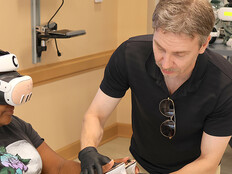





“Students show dramatically increased participation and attention spans in VR environments,” says Edward Huang, a software engineer at Meta Reality Labs. “For example, across 83 Inspired Education Group schools already using immersive technology in the classroom, 90% of students reported increased engagement and interest in their lessons.”
This strong engagement reflects how comfortable students feel learning in a virtual environment. Also, the ability for a student to return to a challenging lesson and practice until they master it highlights how effective VR headsets can be in delivering hands-on learning.
This is especially true with highly technical coursework such as surgical techniques or engineering simulations. “The same research reported that 85% of teachers found virtual and mixed reality to be a valuable tool to enhance their teaching,” Huang says.
DISCOVER: Virtual reality simulations bridge the skills gap.
A Growing List of Learning Applications for VR
Quest VR headsets are finding use cases across college campuses. Meta’s research shows that classes related to science, technology, engineering and math are using the devices for physics simulations, interactive chemistry experiments and mathematical visualizations; for example, Arizona State University is using Meta Quest VR for STEM education and virtual labs.
Skills development is another popular use case, whether the focus is on developing hard skills involved in technical training or using scenario-based learning to develop soft skills. At University of Miami in Florida, students use Quest VR headsets in medical and health sciences training courses.
“Collaborative learning is another popular use case,” Huang says. “Team projects can be worked on in shared virtual spaces by students in different locations. Quest VR headsets are also useful in creative expression, such as 3D art creation, architectural design and prototype development.”
The Power of Combining VR and Artificial Intelligence
On their own, virtual and mixed reality offer unique pathways for delivering immersive, experiential learning. But when VR is paired with AI, a wider array of educational possibilities are unlocked. AI-powered virtual tutors can deliver effective personalized instruction that adapts to the individual students’ learning style and pace. Virtual labs and simulations provide a risk-free environment to conduct dangerous or expensive experiments safely, in fields ranging from chemistry to space exploration.
LEARN MORE: VR technology can be part of a modern learning environment.
“Adaptive learning systems are a great use case, where AI analyzes student performance, adjusting difficulty and providing feedback in real time,” says Huang. “With mixed reality environments, full-color passthrough technology allows instructors to blend digital elements with physical classrooms. There are some amazing educational possibilities."
Getting Started With VR in the Classroom
The setup for bringing VR headsets into the learning environment is straightforward, especially through the Meta for Education bundle. Meta’s Quest 3, Quest 3S and Quest Pro headsets require charging stations and a storage case to protect them when not in use. Meta Horizon Managed Services (HMS) provides a platform for setting up, deploying and managing a fleet of headsets and includes over-the-air updates.
“In addition to device management, HMS provides user management features including privacy-first identity solutions and kiosk mode for shared devices,” says Huang. “App management is covered as well through Meta’s curated educational app store, with content organized by curriculum needs.”
Meta’s HMS also provides some helpful education-specific features. “Share” mode allows multiple students to use the same device while maintaining separate profiles. Classroom management is made easier with built-in tools for monitoring and controlling the virtual experience across all devices.
UP NEXT: What is spatial computing’s future in higher education?
“HMS’s Facilitated Casting feature allows educators to cast to and control up to 48 devices simultaneously for classroom instruction,” Huang says. “We also have a beta version of our File Management feature that supports seamless distribution of education materials through the Admin Center.”
Standard university infrastructure to support a Meta Quest VR headset deployment includes high-speed Wi-Fi (6E is recommended), sufficient bandwidth for multiple users and up-to-date network security configurations. HMS itself uses enterprise-grade security protocols and privacy protections suitable for higher education institutions, and is compliant with all educational data protection requirements.
Immersive Learning Curriculum Development
To support the growing need for curriculum that takes advantage of virtual and mixed reality platforms, Meta is investing $150 million over three years to support the Meta Immersive Learning Fund. This fund supports creator development and training programs, high-quality educational content commissioning, hardware deployment to strategic educational communities and ongoing research into educational applications.
“Meta has also formed some key partnerships with industry leaders to support curriculum development, including Unity, Coursera, Discovery Education and Pearson,” Huang says. “We’ve set up the Meta Quest Developer Hub for content creation, and we offer training programs for educators and technical creators. In addition, Meta offers professional development workshops and certification programs to help developers and educators build curriculum. It’s an exciting area of development.”
Brought to you by: