Like many university instructors, Steven Jackson knows his way around a lecture hall. The rows of seating, the balcony above, the lectern centered carefully at the front — all part of the traditional formula for teaching students in a class of a certain size. But Jackson, vice provost for academic innovation and a professor of information science and science and technology at Cornell University, has no affinity for tradition in this space. Instead, he likes to flip lecture halls on their heads and turn them into hives of active learning.
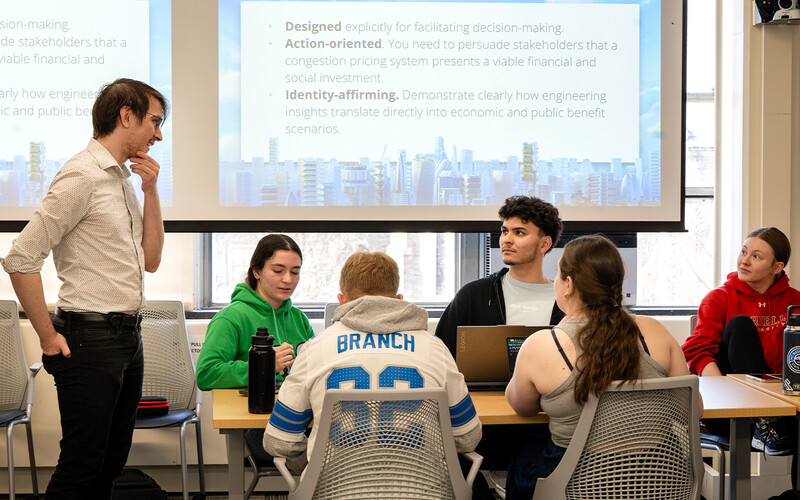
“The classic mode of lecturing is pretty passive, with the teacher on the stage and delivering content and the students sitting and, hopefully, listening,” Jackson says. His approach, on the other hand, tends to have a “different rhythm,” he explains. “I might lecture for five or 10 minutes at a stretch, but then I’ll very intentionally break to a student activity.”
It’s a strategy that Jackson and other Cornell professors are increasingly using in classrooms of all kinds. With support from the university’s active learning initiative within its Center for Teaching Innovation, faculty are redesigning their courses to prioritize in-class discussions and student engagement.
Cilck the banner below for the tools to enable your modern classroom.
Often this is as simple as having students turn to their neighbors “to bounce ideas off each other and talk through their perspectives,” Jackson says. Students share notes, collaborate to solve problems, “and the room can get noisy really fast,” he says. In some cases, teachers decide to leverage technology to help the process along. They’ll use online polling tools, for example, to pose questions for students to answer either individually or as a group. Students access the polls through a mobile device, while instructors use Microsoft PowerPoint, Apple Keynote or Google Slides to present survey activities and real-time results.
Since 2012, when the initiative launched in just six courses across three departments, active learning at Cornell has evolved to become an integral part of the student experience. Today, more than 10,000 students per year attend classes that implement the program’s instructional strategies, Jackson says. “It’s one of those things that, when you look back, it’s hard to believe we used to do it differently.”
READ MORE: Modern learning environments improve student outcomes.
Active Learning Takes Off Nationwide
The idea that many students learn better by doing certainly isn’t Cornell’s alone. From the University of Central Florida to Boston College and the University of California, Berkeley, nearly 8 in 10 colleges and universities now have dedicated active learning spaces on their campuses.
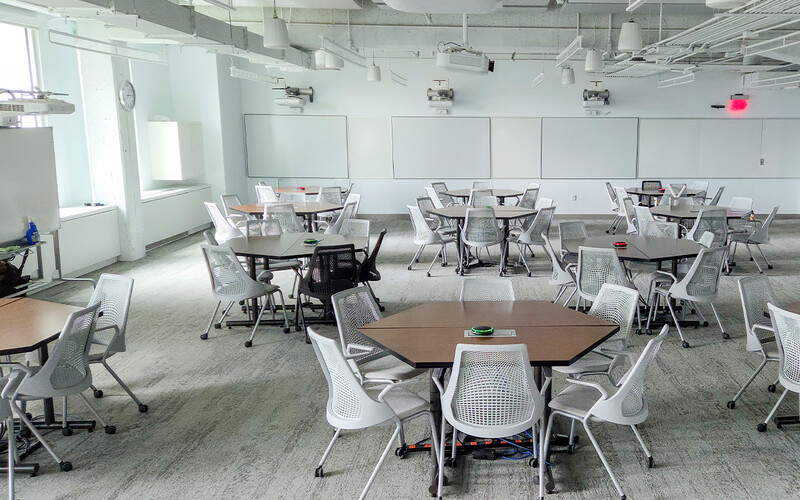
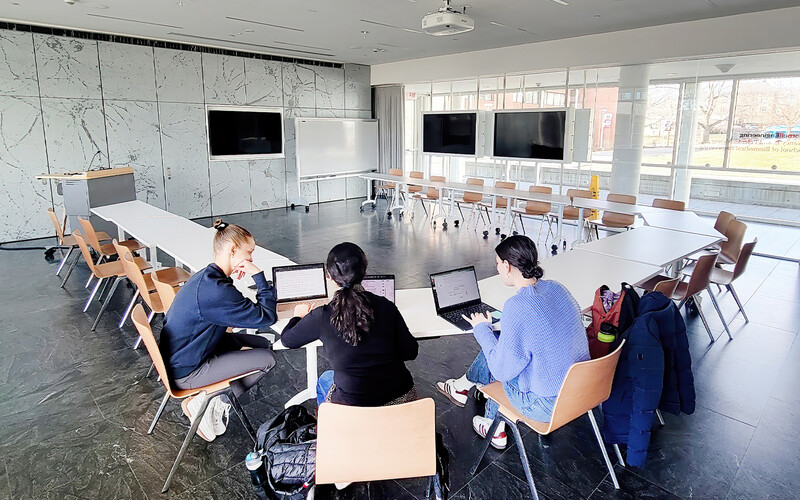
Some of these classrooms, like one at BC that faculty can book for an entire semester, feature movable furniture, ceiling-mounted microphones and digital writing surfaces with wireless projection to multiple screens. At Washington University in St. Louis, “TechPod” classrooms encourage student collaboration with roundtable seating and shared monitors.
“With active learning, there’s a continuum of strategies and activities that faculty can use in their classrooms,” says Kate McConnell, vice president for curricular and pedagogical innovation at the American Association of Colleges and Universities. Space flexibility is one common theme, as students are often asked to move and mingle. And while technology isn’t required, when it’s used creatively and strategically, “its impact on learning can be significant,” McConnell notes.
That’s been the experience for James Scott McGookey, director of learning spaces in the IT services department at Indiana University.
“From my perspective as a technologist, I’m looking for ways to enable students and instructors to practice active learning anywhere,” he says. The department oversees the university’s Mosaic Active Learning Initiative, a program that not only provides training to teachers but also supports the development of certified AL classrooms.
“There’s not one active learning design that we use in every certified classroom, but we do have some standards that we work with,” McGookey says. A typical space includes writable surfaces, easy-to-move tables, and at least 25 square feet per person. At least two electrical outlets are provided for every six students, and projectors and displays are either mobile or optimally positioned for collaborative activities.
Some customized rooms also include screen-sharing capabilities, McGookey says. Technologies meant to facilitate wireless collaboration include Kramer AV systems and Crestron touch panels, among other solutions.
By 2025, the Mosaic initiative had certified more than 130 classrooms and named more than 175 active learning “faculty fellows.” These teachers receive in-depth instruction on active learning techniques, and many then go on to mentor their colleagues as official Mosaic faculty fellow stewards.
This “feedback loop,” as McGookey describes it, also includes opportunities for teachers to meet with his team and share their thoughts on how active learning might be improved. “What’s working, what isn’t working — we want to hear everything,” he says. “That’s how we know that we’re always making progress and making active learning better for everyone.”
Putting Active Learning Into Practice at the University of Georgia
Improving the active learning experience is also a priority for Leah Carmichael, director of active learning at the University of Georgia. The university kicked off its own active learning initiative in 2022, Carmichael says, and today the program offers everything from training for instructors to classroom renovations and infrastructure updates.
UP NEXT: A seamless tech experience is vital for faculty.
One key component of the initiative is an instructional space classification system (developed by EDUCAUSE) for evaluating how well a given classroom might support active learning. Like Indiana University, UGA considers square footage, layout flexibility and access to any combination of low- and high-tech collaboration tools. A large lecture hall with none of these criteria might receive a Tier 4 rating through the system, while a space with all three active learning elements would likely earn a Tier 1 classification.
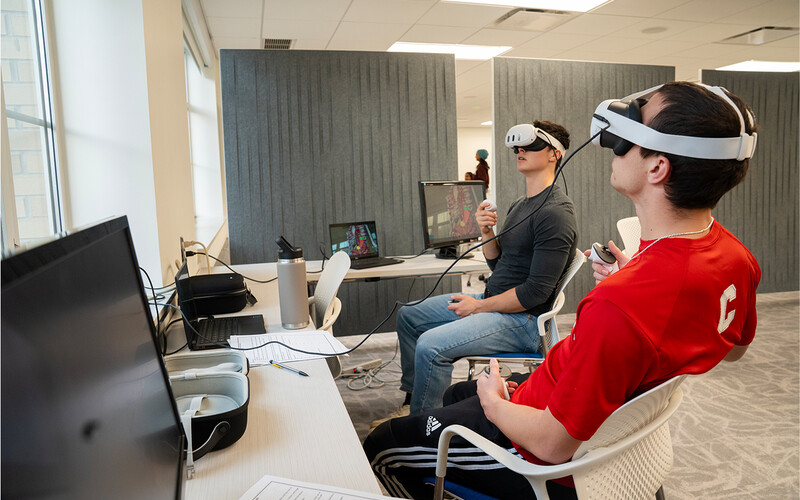
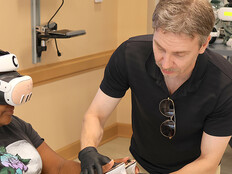
For new classrooms and existing spaces that aren’t conducive to active learning, Carmichael and her colleagues work closely with instructors to add the features they need. Last year, for example, one classroom was equipped with dozens of virtual reality headsets, while another was designed as a “presentation collaboratory,” where students could practice public speaking. In the VR room, Carmichael explains, an ecology teacher might use the headsets to walk her students through a digital frog dissection. “With Wi-Fi and the right software, everyone can have the same immersive experience.”
63%
Student participation rate in active learning sessions, compared with 5% in traditional lectures
Source: engageli.com, “Active Learning Statistics: Benefits for Education & Training in 2025,” Oct. 28, 2025
As an instructor in international affairs, Carmichael remembers clearly what it was like to deliver lectures before she had training in active learning.
“Even today, when I’m in a classroom with stadium seating, teaching the way I want to teach now and getting the students involved — that really requires creative thinking.” She keeps that in mind when she’s working with others on their own active learning strategies, she adds. “If I’m trying to get them to adopt these techniques, I need to understand the barriers they face.”
For higher ed administrators who see active learning as just another buzzword, Carmichael says she’d probably let them know that she was once in the same boat. She decided to learn about active learning after she realized that her lectures had room for improvement. “I was saying to myself, ‘I can be pretty charismatic, I can keep students awake, so why would I need something like this?’ But then it was like, is that really it? Shouldn’t I be trying to do better?”
Moving forward, Carmichael predicts that colleges and universities that embrace active learning will have a ready answer for students who question the need to show up for class. “They can point to the data that shows this is how education should be. This is how to develop those higher order thinking skills that are going to prepare them for the world,” she says.
And the bonus for those people like her, who are tasked with doing the teaching? “With active learning, you’re going to have a more joyful experience as an instructor as well.”