




Close

New Workspace Modernization Research from CDW

See how IT leaders are tackling workspace modernization opportunities and challenges.

Dec 04 2025
Artificial Intelligence

Artificial Intelligence Streamlines Higher Ed Admissions

Innovative institutions are turning to artificial intelligence to address long-standing admissions process challenges.

Southeast Missouri State University, located in Cape Girardeau, Mo., on the western bank of the Mississippi River, is praised by its nearly-10,000 student body for its small-school feel and affordability. But the institution’s embrace of artificial intelligence in its admissions process is positioning SEMO as an innovative university at the forefront of AI adoption in higher education.

SEMO A Track Record of AI Innovation in Admissions

SEMO brought AI technology into its admissions process back in 2023 when it introduced an AI chatbot that could assist prospective students with certain application-related tasks. 

“Because it is embedded in our CRM, it doesn't just give information, it actually helps students complete checklist items,” says Lenell Hahn, assistant vice president for enrollment management and admissions at SEMO. “It can do so much more than just regurgitate information from the website. It actually knows the student's record and can relay information that's very meaningful and personal to the student.”

Click the banner below for insights from college leaders on the impact of artificial intelligence.


In addition to helping students start an application, the chatbot can check their application status, tell them what their missing documents are, register them for an event, schedule an appointment and even congratulate them on their acceptance.

AI assistants were introduced in 2024, allowing SEMO to provide more specialized AI assistance that curated responses based on what category of student was applying: domestic or international, undergraduate or graduate.

In 2025, the university has continued to add to its AI capabilities by introducing AI agents to its admissions process.

“Instead of being reactionary, responding to student outreach, these AI agents are proactive and goal-based,” Hahn says. “We onboard and train them just as we would a human team member. They are given a deadline to complete a goal, such as converting someone from ‘just interested’ to registering for an event or even applying. And the agents can engage students through email, SMS, webchat — even phone calls and voice assistance.”

READ MORE: Universities can use AI to benefit campus physical security.

SEMO Addresses AI Security and Safety

One of the primary drivers for bringing AI into SEMO’s admissions process was the high turnover the university was seeing in its admissions counselor positions, a common challenge facing admissions teams. Losing a human admissions counselor would leave large gaps in the university’s outreach efforts. The AI agents provide a way to deliver consistent communication, outreach and support to students.

“There's just such a breadth and depth of knowledge needed in that position,” Hahn says. “With the onboarding of a human teammate it can take weeks — if not months or years — for them truly to grasp all of that knowledge competently, whereas with generative AI and the knowledge base you build, it can pull answers in seconds.”

SEMO’s comfort with embracing AI stems from a strong relationship with its CRM provider, which has guaranteed a strong focus on guardrails and safety when adding AI features to its platform. Student interactions with AI require an email verification so personal data isn’t inadvertently shared with anyone else.

Lenell Hahn
Instead of being reactionary, responding to student outreach, these AI agents are proactive and goal-based.”

Lenell Hahn Assistant Vice President for Enrollment Management and Admissions, SEMO

In addition, SEMO’s knowledge base is FERPA compliant, and third-party audits are conducted to ensure that data security and privacy standards are enforced. All data within the system is encrypted and requires multi-factor authentication for access.

After an incident where inappropriate content was shared in an AI conversation, SEMO asked that a moderation tool be added to its AI agents.

“Now we have these wonderful moderation tools that flag conversations, and we've got rules set up for what actions we want to happen depending on what the content is,” Hahn says. “They flag us instantly if someone shares an image or text that is considered self-harm. We can also determine, based on a student’s interactions, if we need to block that user for doing something that is violent or discriminatory; we can turn off the AI agent immediately.

WATCH: Bowie State University modernizes its physical security system.

Virginia Tech Adds AI to Essay Review Process

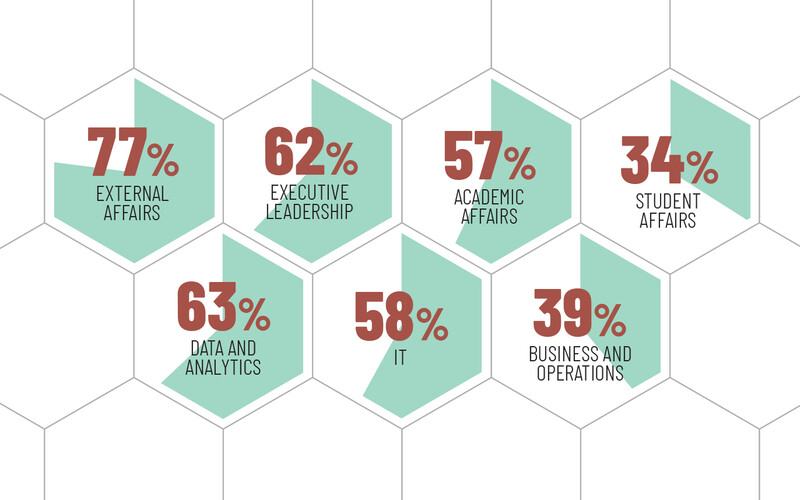
SEMO’s embrace of AI reflects a growing comfort with and adoption of AI across higher education. Ellucian’s “AI in Higher Education: Understanding the Present and Shaping the Future,”report notes that 84% of administrators are personally using AI, and 93% expect AI use to grow even more over the next two years. 

Among AI use cases, admissions was a bright spot for adoption. When considering the use of AI in admissions, 97% of executive leaders think that AI will have a net positive impact. When asked about the use of AI in admissions, 73% of the wider pool of respondents believed it will have a positive impact. 

The leadership team at Virginia Tech shares this optimism. With a student population of 38,000, the Blacksburg, Va., has an enviable admissions challenge. In recent years, its applicant numbers have grown immensely, from 32,000 in 2018 to just shy of 58,000 in 2024.

182 hours

The amount of time saved in August 2025 at Southeast Missouri State University by using AI to manage part of the student and family admissions communications

Source: Southeast Missouri State University

Students were complaining that it was taking the university too long to get final decisions to them. When Juan Espinoza, vice provost for enrollment management, and the admissions staff looked into the problem, it became clear the application’s essay questions were the cause of the bottleneck. 

“Depending on the year, those responses are read by a group of about 200 to 300 volunteer application readers from the Virginia Tech community that have been trained to read them,” Espinoza says. “Each essay question response was read at least twice under our old process, and in some cases, three times. Ultimately, we had 500,000 essay questions that needed to be read. That equates to about 16,000 hours of reading, so that really slowed down our process.”

The admissions office looked internally for a solution to this problem, partnering with Louis Hickman, an assistant professor at Virginia Tech researching applications of AI and machine learning to personnel assessment. Over a period of three years, Hickman worked with the admissions staff to develop an AI tool that can effectively read and score applicant essays. Application essays in Fall 2025 will showcase the inaugural use of this AI essay companion.

“We got to a point of confidence that pairing this AI companion with a human was just as effective as two humans,” Espinoza says. “We have the first human still reading the essay, and then we have the trained AI do the second read. And if there's more than two points difference between the AI companion and the human’s scoring, another human reader will come into play. I would argue that it is a stronger and better quality read than we had under the old system, because we have reduced that differentiation piece from four points previously to two points.” 

As this AI tool is put into use with admissions essays, the admissions staff is focusing on a few key benchmarks for determining success. One is carefully watching how accurately the AI reads the essay and how often it diverges from the human’s scoring. A second benchmark is how much reading time is actually saved with the use of AI. The final indicator is how quickly final decisions go out to students.

“Recently, we’ve been getting decisions out in late February or early March,” says Espinoza. “We hope to roll out final decisions in late January this year. That’s a huge improvement from where we have been in previous years. While we are improving this process, AI is just one piece of admissions review. The decision itself will remain with the humans on our staff.”

Photography by Kristina Krug