At UNLV, Oner has seen that success drives organic growth of Salesforce on campus. As various business units saw what the platform could do, “they started coming to us, rather than us having to recruit them to the platform,” he says. “In meetings across campus, Salesforce became something people talked about.”
To capitalize on that enthusiasm, Oner sought to create Salesforce champions across campus.
“The sweet spot is where technical and functional expertise meet,” he says. “The most effective champions are business leaders who understand their process challenges and can see how technology can be applied.”
At WGU, Morton has effectively combined both these approaches in growing the ServiceNow footprint.
To support organic growth, “we work with the business, whatever the area is that we want to bring in,” Morton says. “We’re getting approval from the vice president of that area. It’s not done in a vacuum. It’s a partnership.”
“ServiceNow has an ecosystem of vendor partners that are experts in both the platform and the capabilities,” says WGU Senior Software Engineering Manager Tina Watson. “When we’re implementing a brand-new capability, we will often work with a vendor partner that has experience with that capability.”
UP NEXT: Customer relationship management software helps manage the student lifecycle.
Software Solutions Lead to Practical Benefits
Universities report a range of tangible improvements when they use a single platform to tackle multiple processes on campus.
O’Brien says the built-in capabilities of ServiceNow make it easy to address new challenges as they emerge.
“We already have the platform up. Now we just need to configure that particular application,” he says. “The effort’s still high, but it’s not like starting from scratch.”
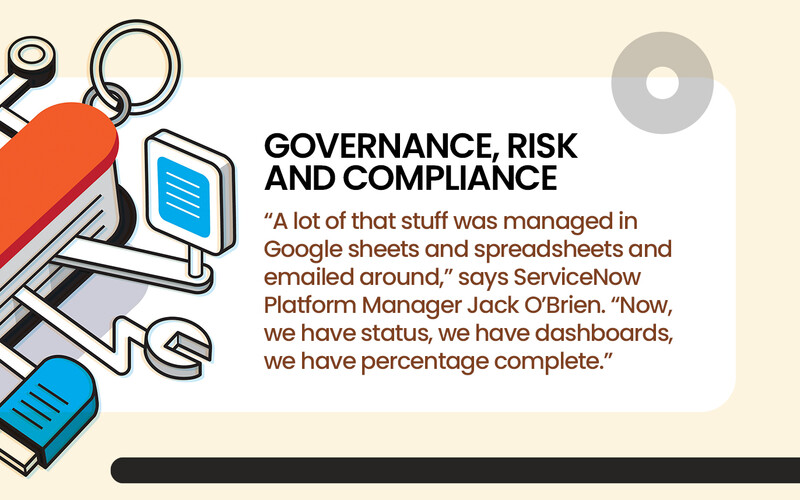
Moreover, the connections between the various use cases on the platform help to deliver a common picture. In the past, “you could have an incident open in four systems, and none of them got updated when you closed it in one system,” he says. “Now, we’ve got one source of truth.”
Morton says the combined data available in ServiceNow makes IT far more responsive. “Having all of that data in one place, we can do really excellent reporting,” he says. “We can identify root causes that would be really hard to understand if data was in disparate places.”
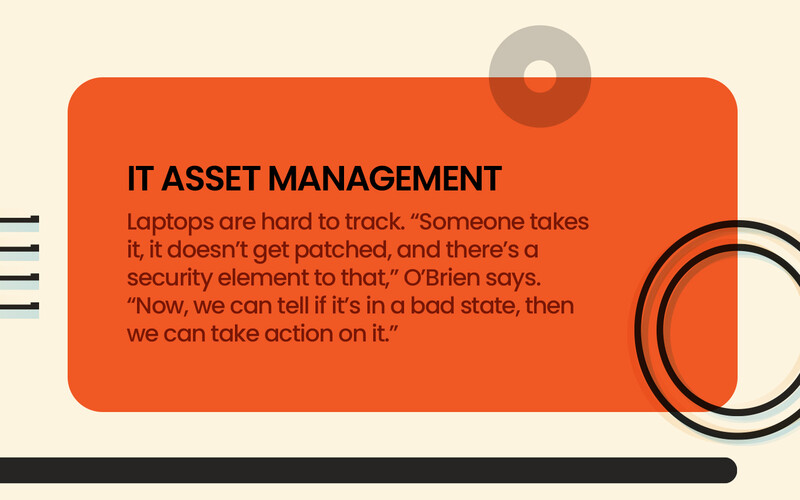
That means IT can solve problems fast. “When vulnerabilities come in, we know right away who they belong to, and it saves the effort to track that down” — which in turns leads to speedier resolutions, Watson says.
For Oner, the single-platform approach helps ensure the university is meeting its primary mission goal: supporting students’ needs.
“We have shifted from a reactive to a predictive model of student support,” he says. “Rather than being the last to hear that somebody had a problem, we are able to anticipate more support needs because of how connected systems are now.”
That has driven measurable impacts.
“Supported by these process improvements, we’ve seen a 61% increase in applications from 2016 to 2024, and a 14% increase in overall enrollment during that same period,” he says. “The retention rate has increased by more than 5%, and our six-year graduation rate has increased by over 10%. I believe that’s partly due to our ability to see a true 360-degree view of the student.”