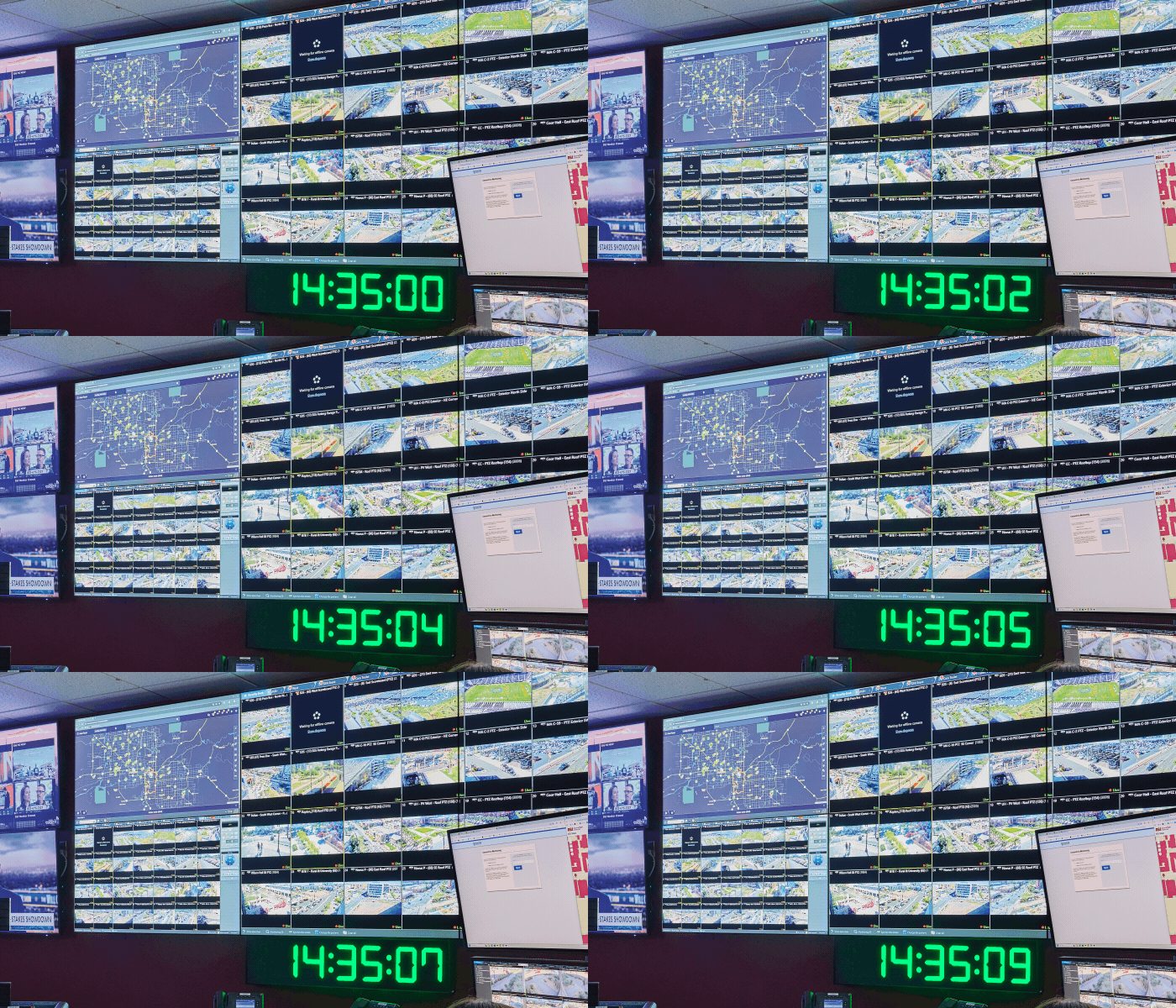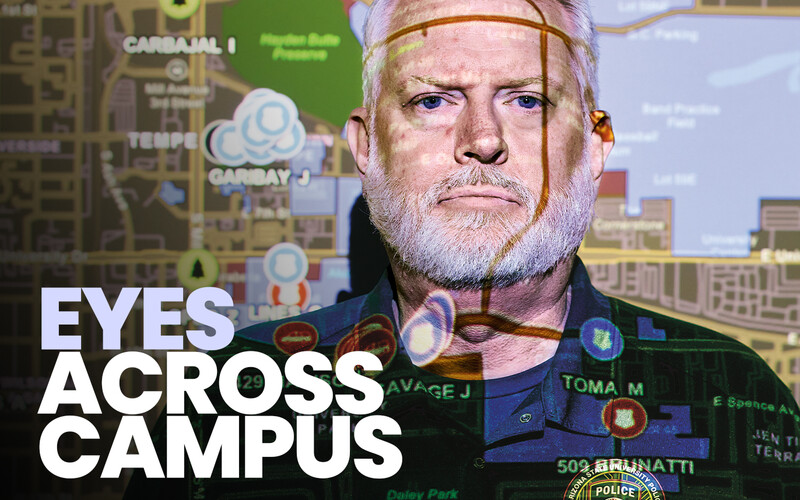






RTAC Manager and Intelligence Analyst Chris Hopkins says these monitoring capabilities have made a big difference in the support the department is able to provide to the ASU community. Property crimes, including bicycle thefts, have decreased significantly since the center was opened, and patrol officers report that their jobs are easier with real-time information at the ready.
“It gives them leverage when they’re investigating that they didn’t used to have,” Hopkins says, noting that his team is like an additional “virtual officer” with a birds-eye view of what’s happening on the ground. Today, when a 911 call comes in, RTAC analysts receive a live transcription, allowing them to immediately zero in on any cameras that could provide critical information to responding officers. And now, when officers apprehend a potential suspect, they can ask the analysts to confirm they have the right person based on their video observations.
“I hate to use the phrase ‘game changer,’ but that’s very much what this is,” Hopkins says. “Everything changes as far as what you can do when you’re operating in a real-time environment.”
AI and Data Analytics: Modern Tools for Monitoring and Surveillance
Higher ed institutions can be like small cities when it comes to their physical safety and security requirements, and that’s doubly true for the many schools that operate within bustling urban environments. With this the case, a growing number of colleges and universities are taking a page out of the modern municipality playbook: They’re opening real-time security centers to provide 24/7 monitoring and surveillance.
DISCOVER: Bowie State University modernized its physical security infrastructure.
At Michigan State University in East Lansing, Mich., the MSU Security Operations Center has been “an unbelievable force multiplier” for his team, says Mike Yankowski, chief of police and executive director of public safety. Like ASU, MSU leverages a Genetec system that combines video management from close to 3,000 cameras with access control and intrusion monitoring technologies. The facility runs around the clock, with 12 employees working in shifts.
“Say we get a call for a theft in progress: Someone stole a backpack in a resident dorm. They’re able to quickly pull up the relevant cameras as officers are en route,” Yankowski explains. Those live images can be used to guide responders if the suspect is on the move and verify whether the individual might be carrying a weapon, for example. With their access control capabilities, team members can monitor for security breaches, and with data analytics tools, they can search video for details, such as the suspect’s shirt color or their getaway vehicle’s direction of travel.
Many of the same technologies are in use across the six campuses of Georgia State University in Atlanta, Ga. L. Jared Abramson, executive vice president and COO, notes that the real-time security strategy came together relatively recently as part of a universitywide safety improvement plan. The university upgraded lights with brighter LEDs, added more lighting in places with poor visibility and installed emergency call boxes in strategic locations across their properties. For access control, it leveraged new software to enable mobile credentialing, and for video monitoring, it upgraded all campus cameras and improved their drone surveillance capabilities.